Memory Kit
Built-in memory decides what to remember. This one asks.
Your agent proposes, you say yes, it writes a dated line into plain files in your own folder. One memory per client, readable by every agent you run, nothing remembered without your yes.



"I wake up already knowing where we left off." — the agent this kit builds.
Install
Three commands in Claude Code, inside the folder where you work. Any folder will do; git is optional, and only needed if you want the wiki and rules to carry their history.
/plugin marketplace add awrshift/agent-memory-kit
/plugin install memory-kit@memory-kit
/memory-kit:setup
That is the technical part, and it happens once. From then on you only talk: work as usual, and
say /memory-kit:close-session when you are done for the day. No database, no service, no
extra cost. Setup reads what your folder already has and proposes before writing anything;
your CLAUDE.md stays yours. Other agents install from the same repository, see
Works with your agents.
Upgrading later, two commands, and the second needs the full id
claude plugin marketplace update memory-kit     # refresh the catalog
claude plugin update memory-kit@memory-kit      # the bare name resolves to nothing
Restart the session to apply. Upgrades never touch your files. Memory, handoffs and knowledge live in your folder, not in the plugin.
The problem
Every session starts from zero: yesterday you locked the brand voice for a client, today you explain it again. Your tools do remember things now, but each one keeps its own notes, outside your folder, and decides by itself what goes in. And memory nobody audits rots: a status note that froze three weeks ago still reads like today's truth, and the agent confidently acts on it.
Memory Kit's answer: one set of plain text files in your folder, written by the agent only after you agree, with a date on every line so a stale fact looks stale.
A day with it
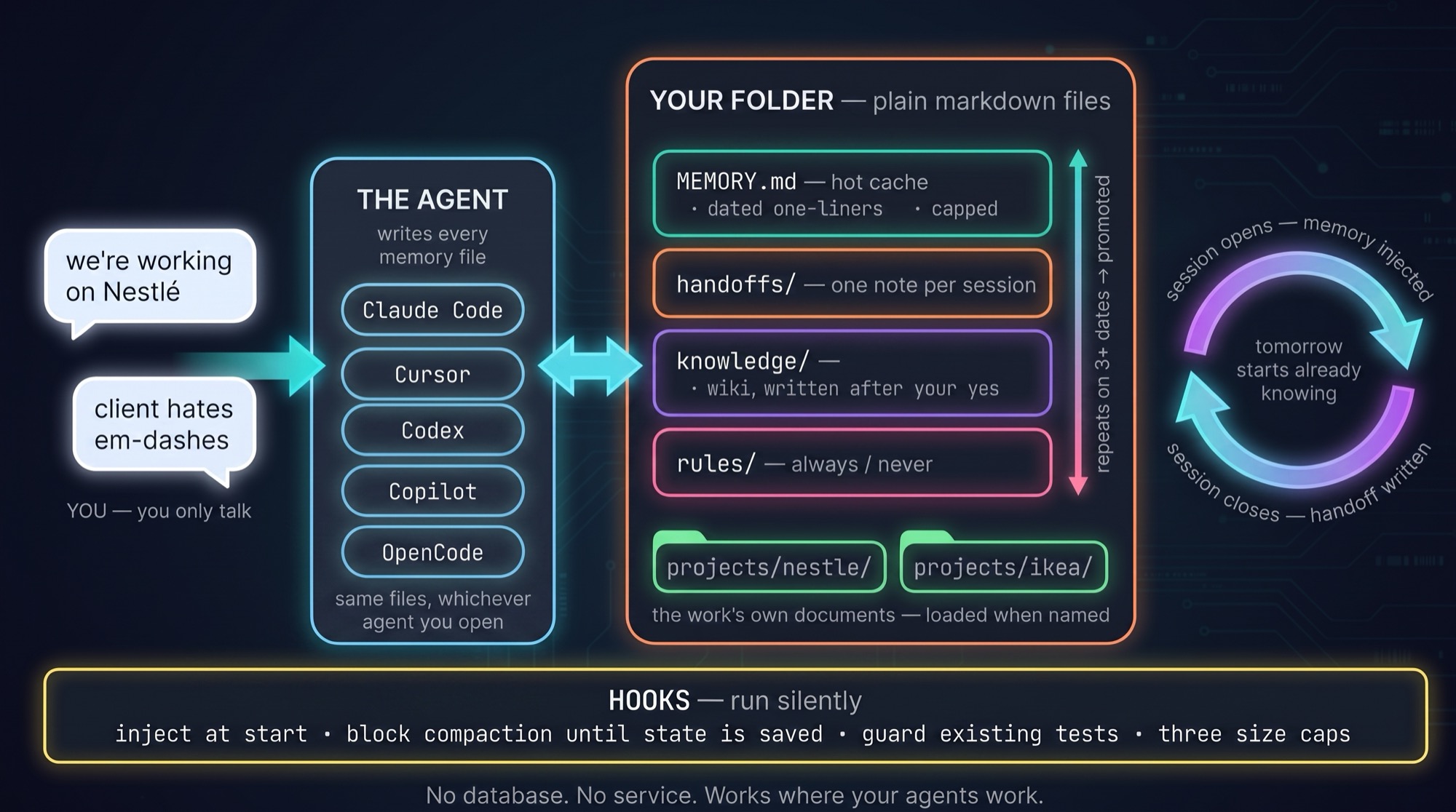
- Open. The agent wakes up already knowing: your hot cache, the note the last session left, and whether memory is healthy. You just continue.
- Work. When something worth keeping comes up, the agent saves it as a dated one-liner and
says "saved". Before the context is compressed, it has to save state. Weakening an existing
test needs your yes, a force push or a hard reset is stopped before it runs, and your
.envand keys stay out of the transcript. - Close. Say you are done for the day. The close ritual audits instead of dumping logs: "you rejected em-dashes on four different dates, make it a rule?" You say yes, it writes, and leaves the note tomorrow's session opens with.
No slash commands in any of this. You talk, the skills trigger from what you said:

The whole session, uncut except for the model's thinking time:
68-second video. Seeded folder, real Claude Code,
reproducible from tools/demo/.
Why not the built-in memory?
Claude Code, Cursor and Copilot all ship memory now, on by default. It is effortless, and it is the vendor's silo. The kit is the opposite trade.
| Built-in auto memory | Memory Kit | Database memory tools | |
|---|---|---|---|
| Who decides what is remembered | the agent, silently | the agent proposes, you approve | the agent, silently |
| Where it lives | the vendor's directory, outside your folder | plain files in your folder | a database or a service |
| Can you read it, diff it, delete a wrong belief | partly | yes, it is text in git | through the tool's UI |
| One memory per client | no | yes, projects/<client>/ |
usually no |
| Read by other agents | no | yes, Claude Code, Cursor, Codex, Copilot, OpenCode | via that tool's integrations |
| How staleness shows | it doesn't | every line carries its date; caps force a prune | it doesn't |
| Cost at session start | its index, up to 200 lines / 25 KB (Claude Code's docs) | 2–4k tokens on a working cache, ~12k hard ceiling at the caps, plus ~2k of skill descriptions (measured 2026-09-02) | tool-specific |
| Infrastructure | none | none | a database, often a daemon or API key |
Running both means two writers and two truths, so /memory-kit:setup asks you to pick.
Either answer is legitimate.
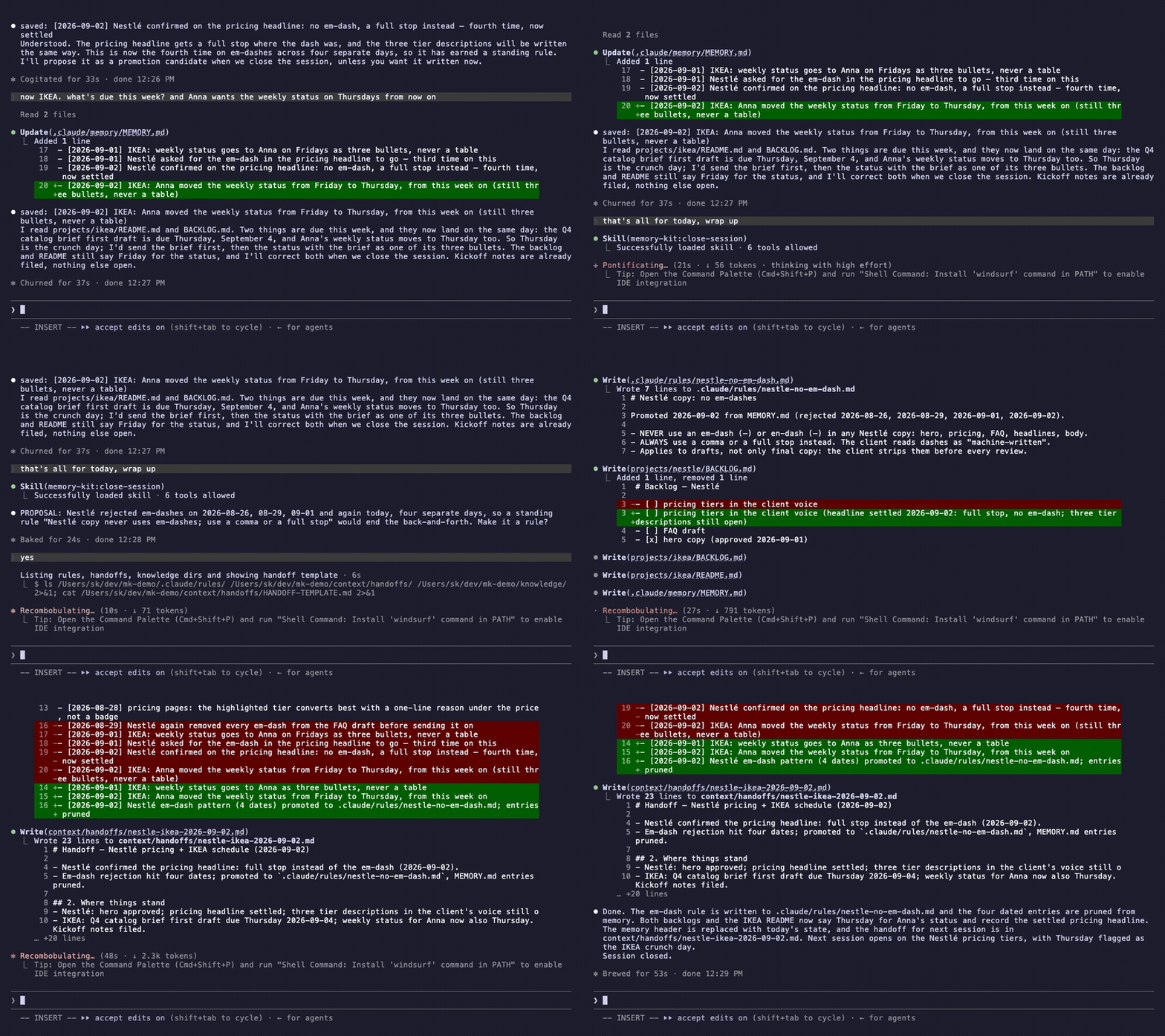
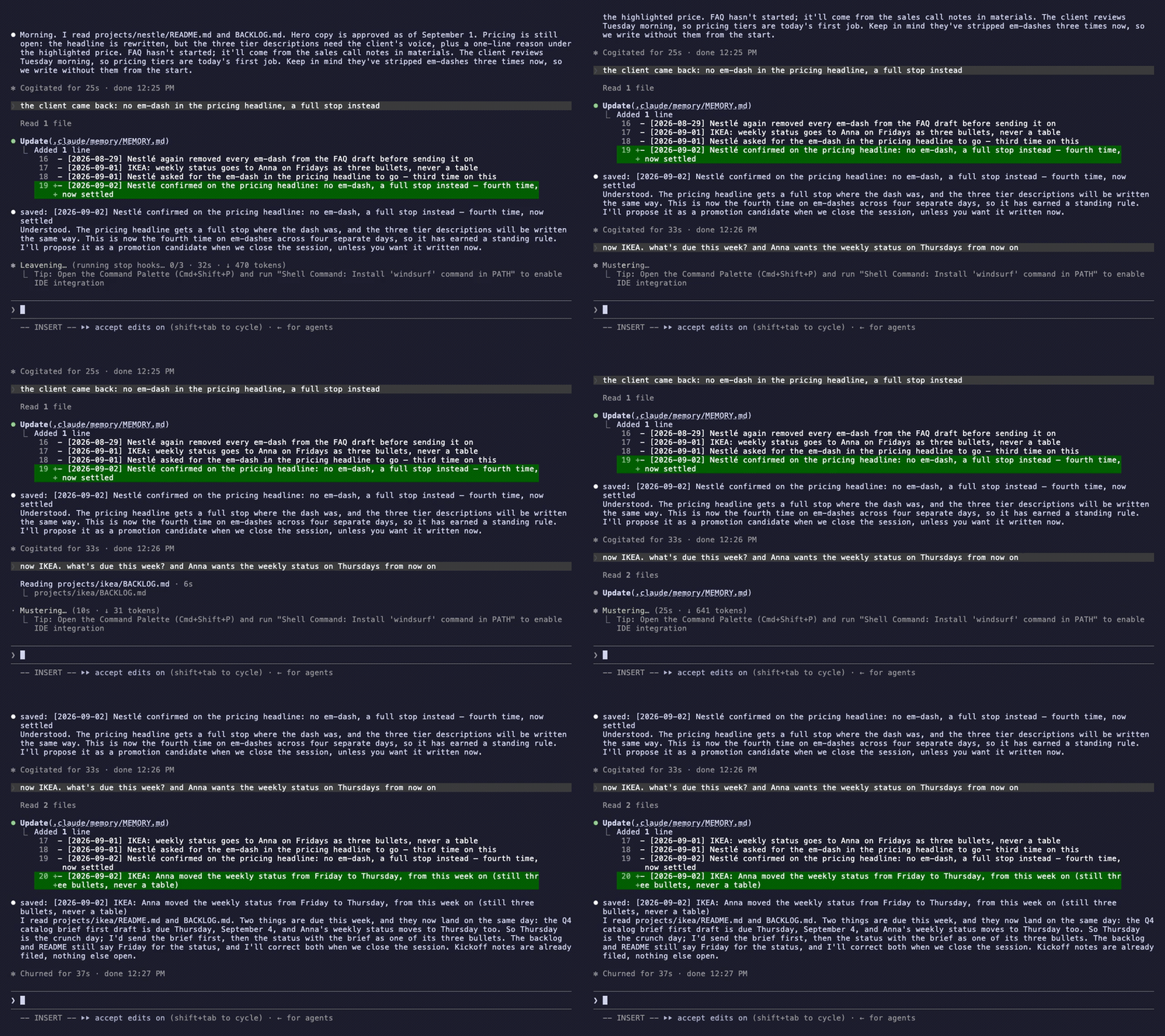
This is the moment the table is about. "That's all for today, wrap up" — the close ritual finds the pattern on four dates and asks; the rule exists only after the yes:
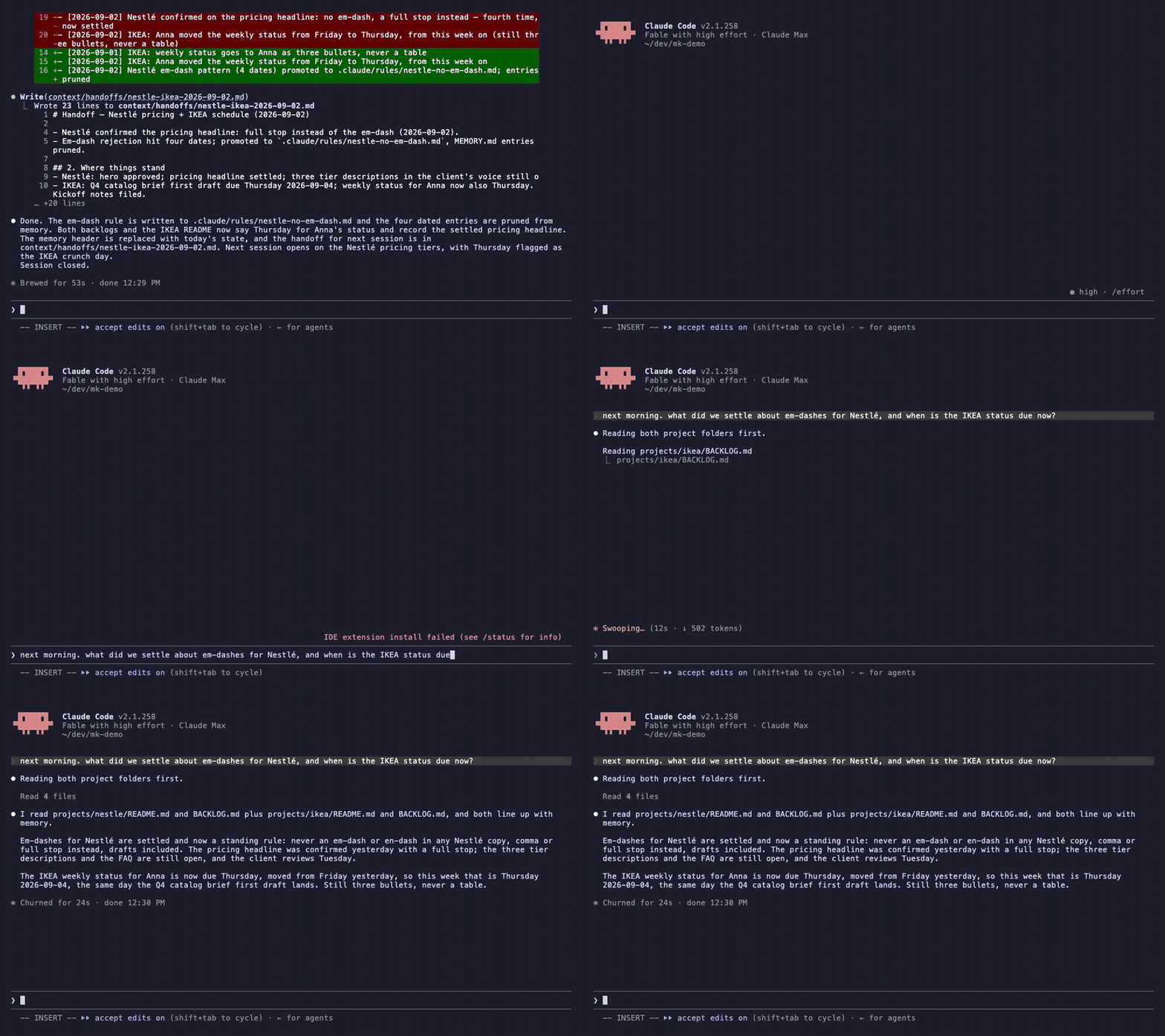
And the next morning, a new session, a plain question:
Many clients, one agent
The line is memory vs paperwork. What the agent learned is shared across everything you
do: patterns, knowledge, rules. What the work produced belongs to one client:
projects/<client>/ holds that client's backlog, specs, research, decisions and QA records.
Say "we're working on Nestlé" and the agent loads that scope only. One folder per client, or
one repository per client, both work.
A pattern's journey: noticed, saved as a dated line, repeats on 3+ dates, the agent proposes promotion, your "yes" makes it a knowledge article or a rule, and the raw lines are pruned. Observation, candidate, law. You approve every step.
"Now IKEA" — the agent reads that client's folder, and a schedule change becomes a dated line without leaving the conversation:
Works with your agents
| Agent | What you get |
|---|---|
| Claude Code | full enforcement: memory injected every session, compaction blocked until state is saved, test edits guarded |
| Cursor | memory injected at session start, all 10 skills (probed at v6's eight) |
| OpenCode | memory injected into EVERY model call via the shipped plugin (verified) |
| Codex | all 10 skills, the memory discipline via an AGENTS.md protocol block (probed at v6's eight) |
| GitHub Copilot CLI | all 10 skills, the AGENTS.md protocol block (probed at v6's eight) |
| Claude Cowork (desktop) | skills only: Cowork does not run plugin hooks yet, so memory is not injected there (documented) |
| Anything else, incl. CI | the memory is plain text in your folder: readable, greppable, git-versioned |
Install commands for the other agents
codex plugin marketplace add awrshift/agent-memory-kit && codex plugin add memory-kit@memory-kit
cursor-agent plugin marketplace add https://github.com/awrshift/agent-memory-kit
copilot plugin marketplace add awrshift/agent-memory-kit && copilot plugin install memory-kit@memory-kit
OpenCode takes one line in opencode.json:
"plugin": ["memory-kit@git+https://github.com/awrshift/agent-memory-kit.git"]
Hosts that cannot run hooks get the same discipline as an always-loaded instruction:
/memory-kit:setup offers a small protocol block for your AGENTS.md. Every claim is probed,
dated and labeled in docs/specs/, degradation stated, never hidden.
Private by default
Everything is plain text on your machine; nothing leaves. The hot cache and the session notes
are gitignored by default, so they stay private even if you push. knowledge/ and rules are
tracked: they are your curated wiki, keep the repository private or prune before publishing.
Working from two machines, or sharing memory with a teammate? Say so at /memory-kit:setup
and the hot cache gets committed instead.
What if I forget to run /close-session?
Nothing breaks. Compaction still refuses to run over unsaved state, and the next session still opens with your hot cache. You lose that session's handoff note and the pattern audit, the deliberate part. Run it next time.
For builders: the orchestration and QA layers (opt-in)
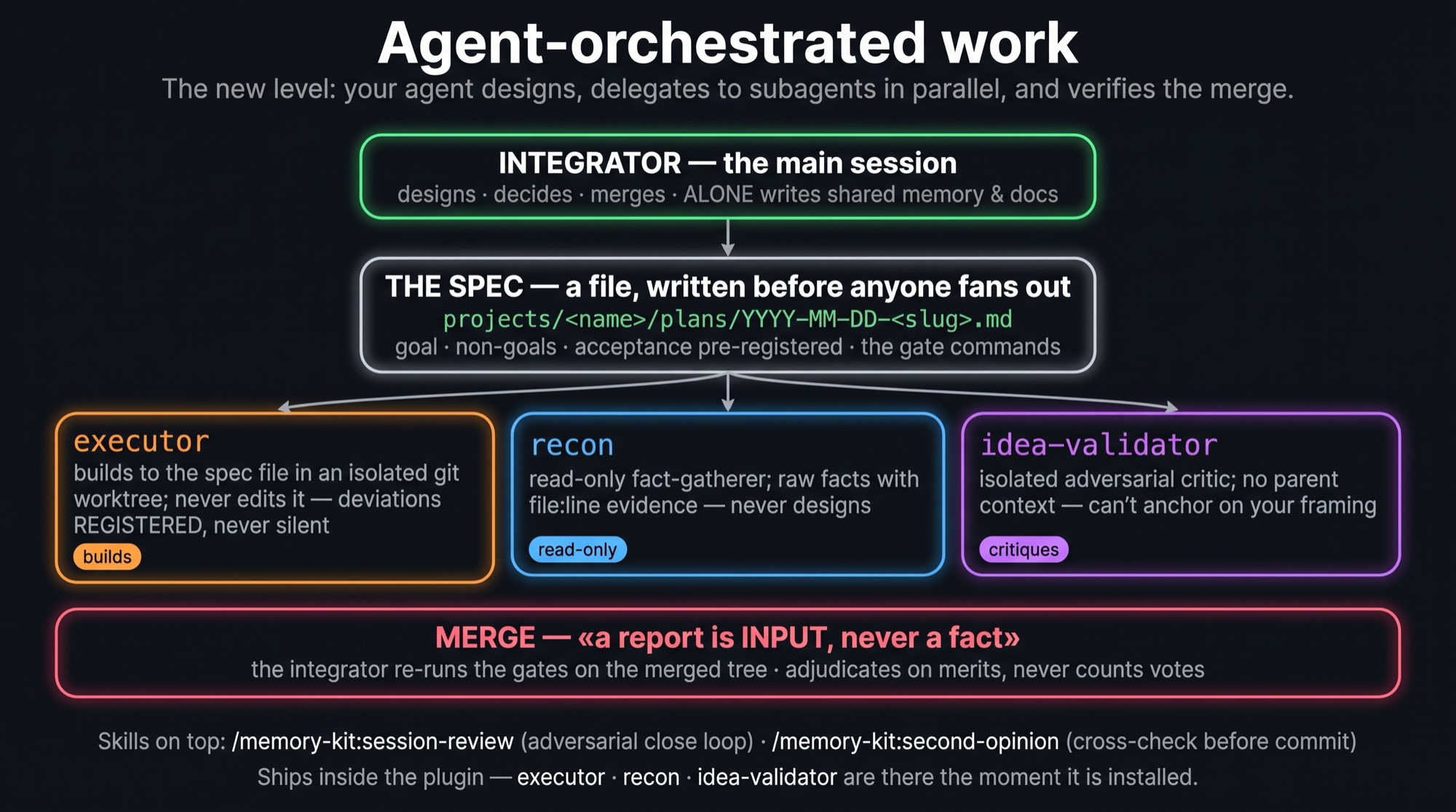
The same plugin carries the orchestration discipline distilled from hundreds of multi-agent
sessions: specs as files with pre-registered acceptance, executor / recon /
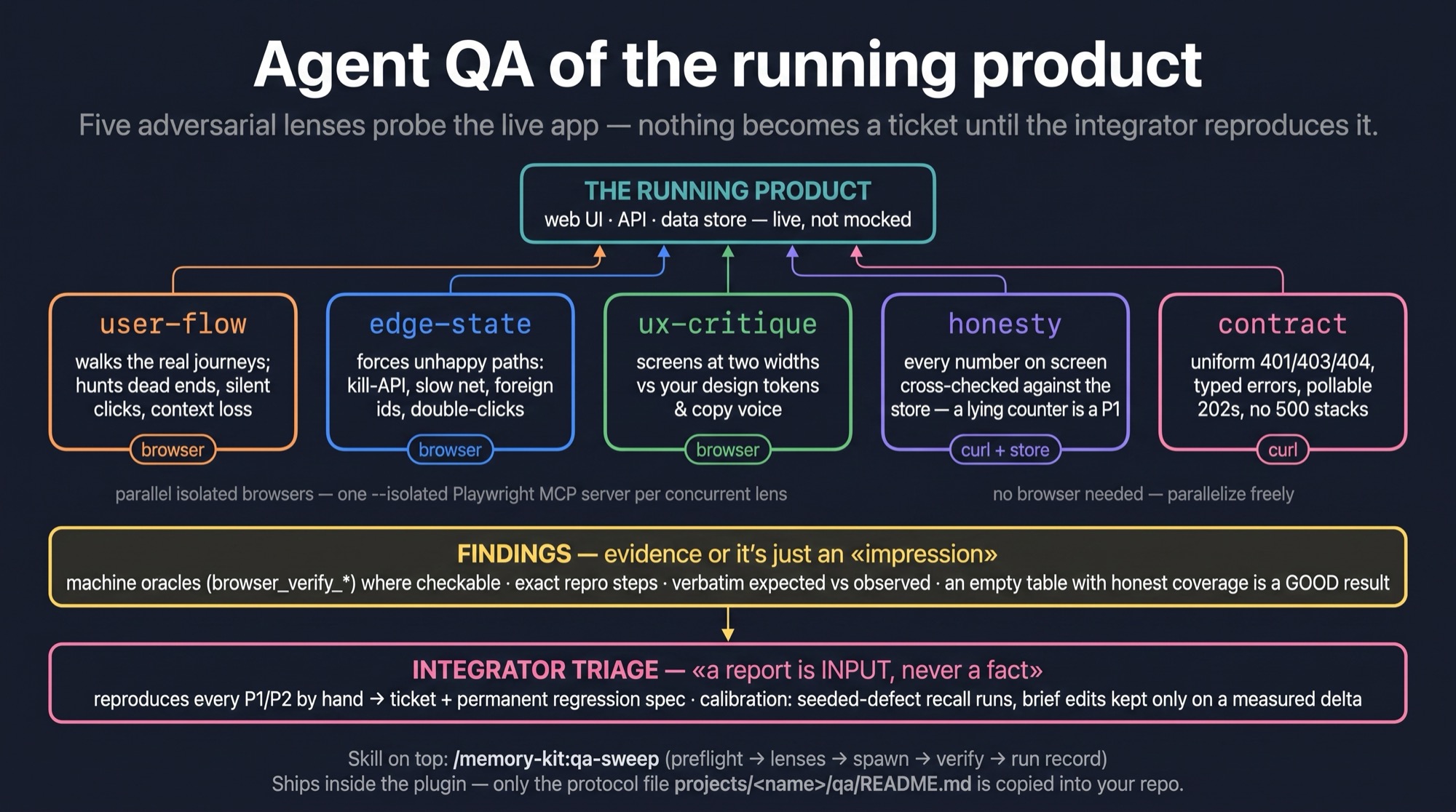
idea-validator agents, adversarial /session-review and /second-opinion, and a multi-lens
/qa-sweep for running products. Two more close the loop: /document writes the PR body,
changelog entry, release note or postmortem from the actual git diff, never from what the
model remembers building; /code-sync walks the specs after a merge and reconciles their
status with what the code now shows, surgically. All lazy-loaded skills, they cost nothing
until invoked.
v7 adds the lifecycle layer that makes those two mean something. A spec's acceptance rows
carry AC-n ids, so a test, a QA finding and a Verified cell can all point at the same
promise. A spec also carries a Value sources table naming where every value it asks for comes
from, and an executor runs an input-coverage gate before its first file: a value with no named
source is an owed decision and the build STOPS rather than inventing one. Each project declares
a workflow tier — prototype · alpha · beta · ga — which sets how much evidence a done owes,
so a throwaway prototype is not held to a GA standard and a GA change cannot pass on a green
test alone. When an executor must override the spec to proceed, it writes an assumed spec:
a recorded override that session start surfaces as owed ratification, and that no skill may flip
on its own.
Depth: docs/ARCHITECTURE.md and the plugin's reference/.
How it is built: where memory lives, what is in the repo
flowchart LR
    T([you talk]) --> H[".claude/memory/MEMORY.md<br/>hot cache · dated one-liners<br/>180 lines / 32 KB / 3000 chars"]
    H -->|"/close-session"| N["context/handoffs/*.md<br/>one note per session"]
    H -->|"same pattern on 3+ dates<br/>and you say yes"| K["knowledge/concepts/*.md<br/>facts + rationale"]
    K -->|"stable, mechanical"| R[".claude/rules/*.md<br/>always / never"]
    N -->|"newest one injected"| S([next session])
    H -->|"injected in full"| S
Four files, each answering a different question. The agent writes all of them, you only talk. Three size caps on the hot cache (180 lines / 32 KB / 3000 chars per line), checked every session, because line count alone lies while content densifies. A stale-reference detector checks that paths mentioned in memory still exist on disk, and a heading named after a session or a date gets flagged — the chronicle belongs in the handoff, the lesson under its topic.
.claude-plugin/marketplace.json   ← THE catalog: Claude Code, Codex and Copilot install from it
.cursor-plugin/                   ← metadata for Cursor's central-marketplace listing only
plugins/memory-kit/               ← the plugin: hooks · skills · agents · templates
docs/specs/                       ← what each host actually honours, probe by probe
docs/ARCHITECTURE.md              ← the full design, with rationale
In your folder the kit owns only state: .claude/memory/MEMORY.md, context/handoffs/,
knowledge/, .claude/rules/, plus one projects/<name>/ per client.
Origin
Built and used daily by one operator since March 2026, across marketing, research and product work, in Claude Code first and the other agents as they arrived. The scars are in the changelog: a daily journal, a rolling status file, a staging layer and several more were retired because they quietly rotted, and for a year the kit claimed its hot cache was "always loaded" while the hook only measured it. v6 found that, fixed it, and CI now checks the injection on every push. What remains is what kept earning its place.
Tell me how your first week went: open a note. It is the only feedback channel, and it decides what gets built next.
Architecture: docs/ARCHITECTURE.md · Per-host specs: docs/specs/ · Changelog: docs/CHANGELOG.md · Contributing: docs/CONTRIBUTING.md · Open decisions: docs/DECISIONS.md
MIT, see LICENSE.