understanding-ladder
Agent skills that make LLM explanations easier to understand — built on Karpathy's understanding ladder.
English | 中文



npx skills add ChangWenC/understanding-ladder
Live demo → one explanation, rewritten at every rung.
Why
In October 2026, Andrej Karpathy wrote that LLM output is nearly free; understanding it is the bottleneck. So stop accepting walls of text and ask for formats that are easier to understand. He ranked four, each "even better" than the last:
| Rung | Format | Why it helps |
|---|---|---|
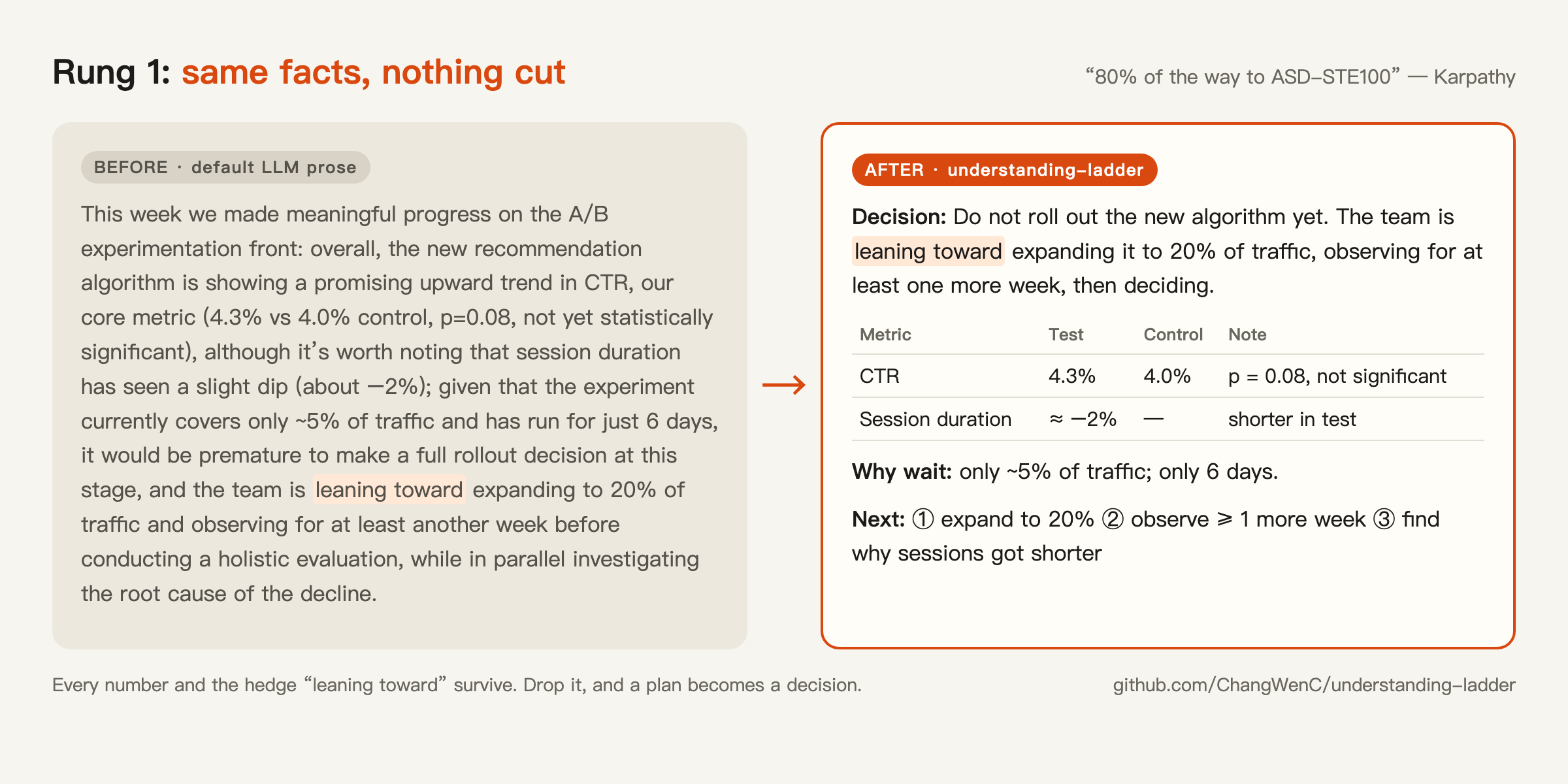
| 1 | Text in ASD-STE100 (controlled English) | One idea per sentence, one meaning per word |
| 2 | Diagram | Structure laid out at once instead of line by line |
| 3 | Interactive HTML page | Move the parameter, see the result change |
| 4 | 3Blue1Brown-style explainer video | Animation + narration for processes over time |
The hard part is not knowing the ladder. It is picking the right rung every time without being asked — and not climbing higher than the question needs. This repo turns that into a skill.
What you get
understanding-ladder — which format
Classifies the content, recommends the lowest rung that fully answers, and produces it:
| Content | Rung | Output |
|---|---|---|
| Definition, fact, procedure | 1 · text | ~80% ASD-STE100 in English, plain-chinese in Chinese |
| Process, causality, states, components | 2 · diagram | Mermaid / SVG + "how to read this diagram" |
| A parameter changes the outcome | 3 · page | Single-file HTML with sliders, opens with a double-click |
| A derivation that unfolds over time | 4 · video | Storyboard + narration; showtime ≥ 0.4.0 renders it with --from-storyboard |
Three rules hold on every rung:
- Nothing cut. Simple language, not less content. Every number, condition, and hedge survives.
- Draft first. Every diagram, page, or video starts from a rung-1 text draft you can check.
- "What to check" at the end. Easier to understand ≠ verified.
Works in English and Chinese — it replies in your language.
→ SKILL.md · English examples · Chinese examples
plain-chinese — rung 1 for Chinese
In English you can just say "in ASD-STE100" and the model knows the rules. Chinese has no such name. plain-chinese spells the rules out: 15 of them, grouped into words, sentences, paragraphs, what to delete, and what to keep. understanding-ladder calls it automatically for Chinese output.
→ SKILL.md · 5 before/after pairs
Demo: one explanation, every rung
Topic: why does server latency explode once utilization passes ~80%?
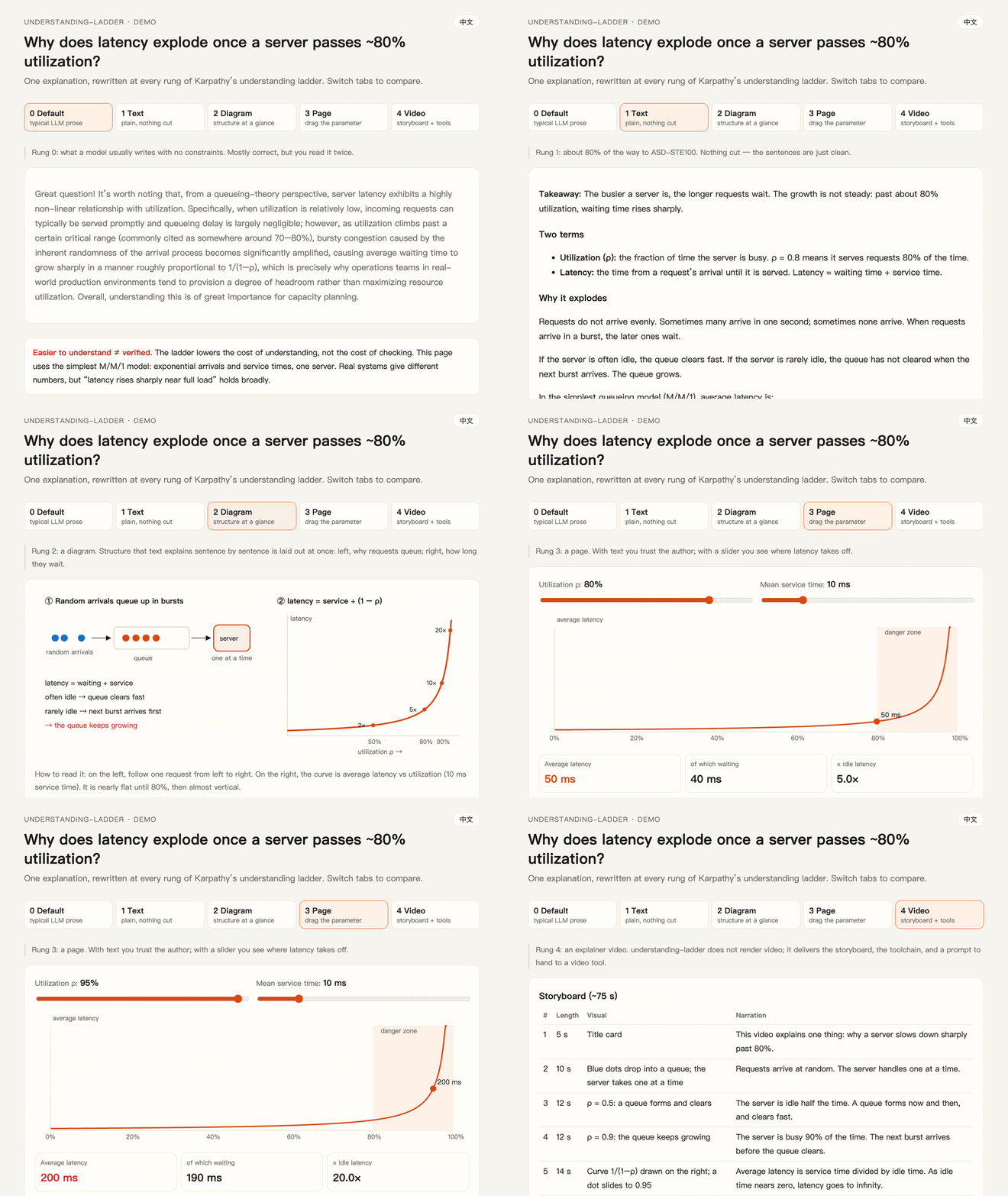
Open the live demo (English / 中文 toggle, single file, no dependencies). Tab 3 has a slider: drag utilization from 90% to 95% — five more points, double the latency.
Install
Any agent that supports Agent Skills (Claude Code, Codex, Cursor, …), via skills:
npx skills add ChangWenC/understanding-ladder
Claude Code plugin:
/plugin marketplace add ChangWenC/understanding-ladder
/plugin install understanding-ladder@understanding-ladder
Manual (Claude Code global skills directory):
git clone --depth 1 https://github.com/ChangWenC/understanding-ladder.git
cp -r understanding-ladder/skills/* ~/.claude/skills/
Use
Just ask. The skill triggers from its description:
Help me understand how learning rate affects convergence.
Explain the TLS 1.3 handshake the clearest way.
An agent wrote this plan — help me see what it actually does.
Walk me through the Fourier series from rung 1 to rung 4.
No install? Paste this (Karpathy's "80%" plus the one rule that matters most):
Write about 80% of the way to ASD-STE100: one idea per sentence, one term per meaning, active voice, no filler. Cut nothing — keep every fact, number, condition, and hedge; just make the sentences clean.
Limits
- Easier to understand ≠ verified. The ladder lowers the cost of understanding, not of checking. A polished artifact lowers your guard; an error in an animation is more convincing than in text. Hence "What to check" on every output.
- Rung 4 writes the storyboard; rendering is done by a video tool. showtime 0.4.0+ reads the table directly (
showtime new <template> <dir> --from-storyboard storyboard.md, English or Chinese headers). plain-chineseis a lightweight rule set for LLMs, not a full writing standard. Sentence-length numbers are rules of thumb, not tested in reading studies.- The examples were produced by following the skills and checked by hand. They show direction, not a benchmark.
Related work
| Project | What it does | Difference |
|---|---|---|
| FutureAtoms/karpathy-ladder | English ladder skill; renders diagrams, spec sheets, and video with Playwright/Manim | This repo is zero-dependency, picks the lowest sufficient rung, and covers Chinese |
| danyuchn/asd-ste100-skill | English STE rewriting with a linter | Rung 1 only; this repo covers the whole ladder |
| mzopedia/simplified-technical-chinese | A full Simplified Technical Chinese spec: 40 rules, word list, checker | Heavier and more formal; use it for documentation. plain-chinese targets LLM explanations |
Ideas only; no content copied.
Credits
- The ladder comes from Andrej Karpathy's post.
- Rung 1 is inspired by ASD-STE100; not affiliated with ASD. No STE rule text or dictionary is reproduced. ASD-STE100 is a registered trademark of ASD.
- Rung 4 tools: showtime, Manim, Kokoro.