


An espalier trains a fruit tree to grow flat along a wall — pruned, wired, productive. Espalier does the same for your AI coding agents: it reads your codebase, discovers the patterns already in it, and encodes them as machine-enforced guardrails. Generated code grows along your conventions on the first try, not the fifth.
Quick start
/plugin marketplace add Junhanliu-dev/espalier-engineering
/plugin install espalier-engineering@espalier-engineering
/espalier-init
That's it. One ~10–15 minute setup per repo, then every future change reuses it.
The problem
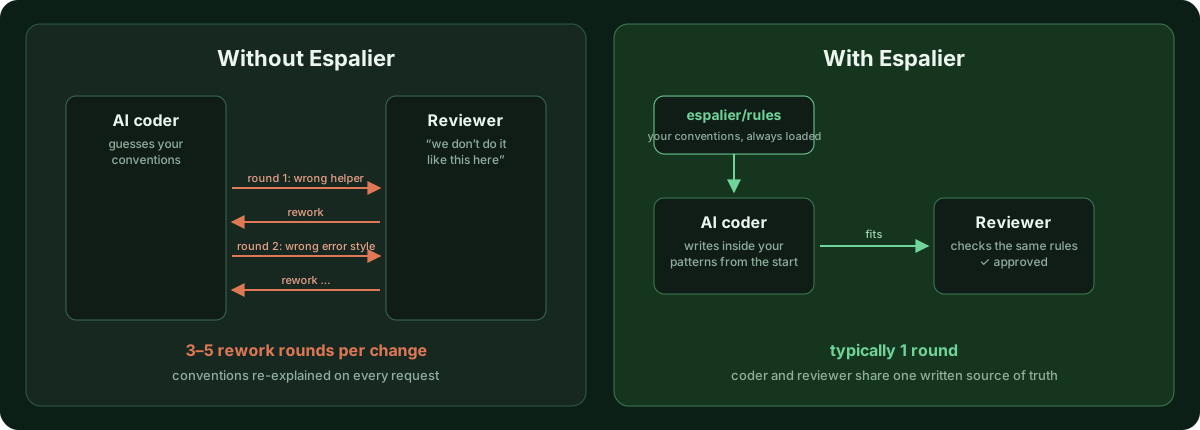
AI coders write plausible code that doesn't fit your codebase. They invent helpers you already have, pick libraries you don't use, and throw where your repo standardised on Result<T> years ago. It's not a model-intelligence problem — it's an unwritten rules problem. The model can't read your team's Slack history.
How it works
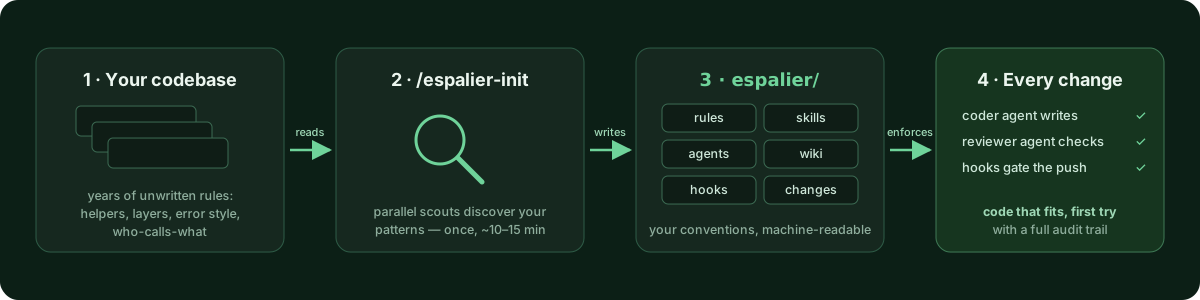
/espalier-initdiscovers — parallel scout agents read your code and extract the conventions nobody wrote down.- It writes them down — as a per-project
espalier/directory: always-loaded rules, phase-loaded skills, sub-agent definitions, a wiki, and programmatic hooks. - Every change is gated — a coder agent writes, a separate reviewer agent (different tool set) checks against the same rules, and hooks block pushes that skip the gates.
- It stays honest — drift detection flags docs the code has outgrown; refreshes are gated, never silent.
espalier/
├── rules/        # always loaded: coding standards, security, production standards
├── skills/       # the pipelines: /espalier, /espalier-fix, /espalier-ask, …
├── agents/       # harness-coder / harness-reviewer / harness-security
├── wiki/         # architecture, data models, critical paths
├── hooks/        # programmatic gates: layer checks, pre-push, drift detect
├── maps/         # multi-session decision maps
└── changes/      # typed audit trail — one folder per requirement
The commands
| Command | What it does |
|---|---|
/espalier-init |
One-time setup: discover conventions, generate + wire the guardrails |
/espalier <feature> |
Full 10-stage pipeline: grilled requirements → your approval → code → independent review → tests → gated push |
/espalier-fix <bug> |
Slimmer bug-fix lane that auto-links each fix to the change that caused it |
/espalier-ask <question> |
Read-only Q&A — answers from your docs, verified against the code, every claim sourced |
/espalier-audit |
Repo-wide security audit of existing code; findings hand off into fix runs |
/espalier-simplify [scope] |
Evidence-first simplification survey of existing code — proven cuts file as refactor changes the pipeline runs; the docs that described them get flagged for prune |
/espalier-map <idea> |
Plan work bigger than one session (epics, greenfield) as a decision map |
/espalier-maprun |
Execute a cleared map: headless workers in isolated worktrees, reviewable slice PRs |
/espalier-doctor / /espalier-prune |
Detect doc drift / refresh a stale doc (gated) |
/espalier-migrate |
Upgrade an existing install to the current version |
Highlights along the way:
- Grilled requirements — before any code, Stage 1 interrogates the request exactly as hard as its vagueness warrants, then stops for your explicit sign-off. Later stages execute a spec they can't misread.
- Separate judge — the reviewer is always a different agent with read-only tools. It can't rubber-stamp its own work, and a security auditor joins it on every change's trust boundary.
- Causal links — six months later, "why does this feature have 4 fixes against it?" is answered by the audit trail, automatically.
- Team-ready — on multi-dev repos, upkeep collapses to one rotating person's ~15-minute weekly job (how it works).
Works with your agent — whichever it is
The espalier/ directory is platform-neutral; init wires it into any subset of:
- Claude Code — auto-loaded via
.claude/symlinks + settings hooks - OpenAI Codex — repo skills,
AGENTS.mdsection,.codex/agents + hooks (guide) - GitHub Copilot — Agent Skills,
copilot-instructions.md,.github/agents + hooks (guide)
Same rules, same gates, on all three. Add a platform later with one re-wire — nothing is ever unwired.
Manual / per-project / Codex / Copilot install commands
Manual git clone + symlink (Claude Code)
git clone https://github.com/Junhanliu-dev/espalier-engineering ~/repos/espalier-engineering
ln -sfn ~/repos/espalier-engineering/skills/espalier-init ~/.claude/skills/espalier-init
Restart Claude Code; update later with git pull.
Project-scoped install
mkdir -p .claude/skills
ln -sfn /path/to/espalier-engineering/skills/espalier-init .claude/skills/espalier-init
Codex (OpenAI)
git clone https://github.com/Junhanliu-dev/espalier-engineering ~/repos/espalier-engineering
mkdir -p ~/.agents/skills
ln -sfn ~/repos/espalier-engineering/skills/espalier-init    ~/.agents/skills/espalier-init
ln -sfn ~/repos/espalier-engineering/skills/espalier-migrate ~/.agents/skills/espalier-migrate
Restart Codex, run $espalier-init, pick Codex (or Both) at the platform question. After init: restart Codex, trust the project, run /hooks once to trust the two quality gates. Pipelines are $espalier, $espalier-fix, $espalier-ask, $espalier-audit.
Already ran init from Claude Code? Add Codex wiring without redoing discovery:
bash ~/repos/espalier-engineering/scripts/bootstrap-espalier.sh \
  --wire-only --platforms=codex \
  --plugin-dir=~/repos/espalier-engineering/skills/espalier-init --yes
GitHub Copilot
git clone https://github.com/Junhanliu-dev/espalier-engineering ~/repos/espalier-engineering
mkdir -p ~/.copilot/skills
ln -sfn ~/repos/espalier-engineering/skills/espalier-init    ~/.copilot/skills/espalier-init
ln -sfn ~/repos/espalier-engineering/skills/espalier-migrate ~/.copilot/skills/espalier-migrate
Reload VS Code (or restart Copilot CLI), run /espalier-init, include GitHub Copilot at the platform question. Sub-agents are @harness-coder / @harness-reviewer / @harness-security. Add Copilot to an existing install with --wire-only --platforms=copilot as above.
What it costs
Init is a one-time ~$2–5 on a medium repo (Opus main + Sonnet scouts + cache). Without Espalier, every request re-discovers your conventions and burns 3–5 review rounds — you typically earn the init cost back within 5–10 feature requests. Full token/cost breakdown, plan budgets, and per-command cost classes: docs/usage-cost.md.
Skip Espalier for: throwaway prototypes, single-file scripts, solo projects where consistency doesn't matter. For anything you'll iterate on for weeks, it pays back fast.
Philosophy
When an agent makes an error, engineer its elimination — not with prompt tweaks, but with files, rules, automated checks, and system structure.
- Discover, don't prescribe — extract patterns from the actual code; never impose templates.
- Quality gates must be programmatic —
ci_status == 'success', not "check if CI passes". - Separate execution from judgment — coder and reviewer are different agents with different tool sets.
- Context layering — rules always loaded; skills per phase; wiki on demand.
- Every rule has a reason — an observed pattern, or a known failure mode it prevents.
Latest release
v0.28.1 — the trim. Every shipped agent, skill, rule, and stage template says the same rules in fewer lines (8,723 → 8,611 template lines, −1.3%, across 23 files) with every rule, gate, rubric, sentinel, tag, cap, path, heading, and code fence byte-identical — only restated rationale, history notes, doubled sentences, and section announcers went; point-of-use repeats, exceptions, and the one worked example per format stayed on purpose. Migration #39 introduces a reusable mechanism for text-only refreshes: the release ships its exact template diff and applies it per file with git apply, all-or-nothing per file — a pristine file trims byte-for-byte, a customised file is left untouched and recorded (nothing to port). No new check, key, or hook.
v0.28.0 — the ceiling ledger. Second idea-level transplant from DietrichGebert/ponytail (MIT), inside the same rule as the first: conventions first, correctness within them, clarity then brevity break ties; every gate, rubric, verdict sentinel, round cap, and escalation path is contract-equal to v0.27.0, and every new finding is advisory P3. A deliberate shortcut with a KNOWN ceiling (a global lock, an unbounded scan, a naive heuristic, a cache with no eviction) now carries ONE line at the site — ceiling: <limit>; <trigger> — the one comment the budget already allows, so the upgrade path stays attached to the code it constrains instead of buried in a change folder; the reviewer files [ceiling] / [no-trigger] at P3, espalier-stats.sh prints the ledger (ceilings: markers=N no-trigger=M, one row per marker with its blame date), and /espalier-simplify hands every marker to its scouts as a lead (a fired trigger is a cut or an upgrade change). The ladder's rung 4 opens a shipped references/platform-native.md lookup ("you think you need X / the platform has Y") when conventions are silent; the floor keeps physical-world calibration knobs; a fix lands where every caller routes through, never on the reported path alone; the reviewer gains a shrink: tag that is invalid whenever the shorter form would draw a Readability row; the grill counts an over-specified mechanism as a signal and lands the requester's choice as a Scope out-line or a kept criterion. No new lane, skill, or command. Migration #38, validation check 70 (60 / 65 / 70 by platform set). Design and the rejected pieces (intensity modes, "ship lazy and question", a one-check test minimum, net: -N lines): docs/ponytail-v4-transplant-plan.md.
v0.27.0 — finding the unknowns. The map (requirements.md) is not the territory (the code); v0.27 gives the pipeline a channel for what the territory teaches during and after implementation — with the contract still frozen and every resolution a human's. The coder logs each departure from an approved criterion under ### Deviations (the conservative option, the path:line contradiction, what was left undone) or stops with - BLOCKED-ON-REQUIREMENT: for the human to resolve — it never edits requirements.md; the reviewer's Deviation Review verifies the block every round ([deviation] P1), the auditor files a relaxed control as P0, the Stage 4 PASS prints the deviations, Stage 10 presents an assembled delivery-brief.md and offers a quiz. Before coding, the grill reads the map to an unfamiliar requester first (Step 1.6, cited, never a proposal), shows its candidate builds at full tier, and records an undecided approach instead of choosing; ## References carries the requester's named model; the approval gate leads with the decisions most likely to change. Contract-equal to v0.26.0 — no gate, rubric, sentinel, or cap changes; nothing sets a budget. Migration #37; validation 59/64/69. Design: docs/unknowns-plan-v1.md.
v0.26.0 — turn economy. Fewer agent turns and fewer spawns for the same gates, measured on real runs (a coder spawn is ~37 model turns at ~15s each; model latency is flat across context size; the contract phase was a second cold coder spawn that mostly re-verified tests already in the diff). Coders write the abuse test for every sensitive field they classify with the code and verify each cycle with ONE call — exit_gate, the gate's own commands. The auditor's contract carries covered_by: per entry, so a fully covered contract spawns no contract-phase coder and goes straight to the delta review, which still proves every entry itself (a covered_by that does not hold is its P0). The session-boundary preference is asked once at the approval gate (- Session-Boundary:); the Stage 2 and Stage 4 boundaries read it instead of asking. The bash blocks the orchestrator retyped every run are helpers now — regression_verify, record_commits, certificate_write, drift_index, stage85_drift, backlink_all. exit_gate scopes monorepo ((cd WS && CMD) || return 1 per line) and uv run pytest test bodies and starts tests as soon as the build is green; the push hook runs build ∥ lint by default. espalier-stats.sh shows contract phases covered at Stage 3 vs coder-spawned. Every gate, rubric, sentinel and round cap is contract-equal to v0.25; nothing sets a budget. Design + field data: docs/pipeline-speed-plan-v4.md, docs/pipeline-field-report-2026-09-14.md.
Full history and migration guides: CHANGELOG.md · upgrade any install with /espalier-migrate.
License
MIT — see LICENSE.