Interlock
Spec-driven development for Claude Code. You read one spec; parallel agents ship it to a tested commit.






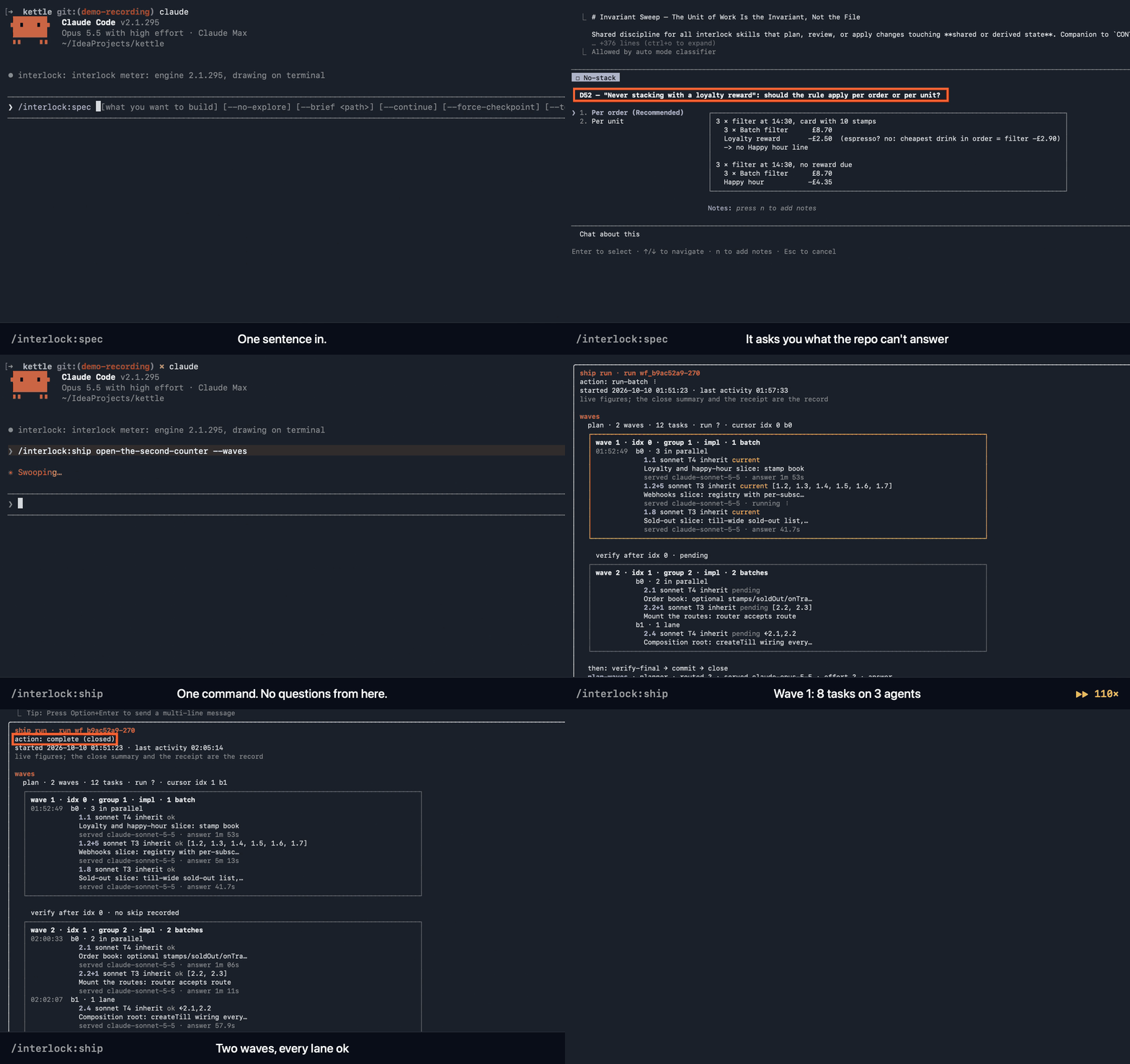
One real run, cut to 34 s. spec asks one question, writes 11 specs and 12 tasks, then stops. ship runs three agents in parallel across two waves and ends in a commit with the suite green, 180 of 180.
12 tasks · 2 waves · 19 agents · 13m 54s · 57 files · 2,881 lines · 180 of 180 pass · 1 commit
The whole run, uncut and captioned: 2:34, mp4, 9 MB.
/interlock:spec "<idea>" # explores your repo, writes a reviewed spec, then stops
# ← you read it. The only place a human is required.
/interlock:ship # parallel agents implement → your tests pass → commit. Nobody is asked.
- One human checkpoint. A spec is the cheapest place to catch a wrong idea, so that is the one place you must look. Everything after it is automatic.
- Zero-touch by construction.
shipis a Claude Code workflow, and the workflow runtime has no channel for mid-run input. It cannot ask you anything, so it never does. - Caps and gates are code, not prose. Parallelism, retry budgets and review thresholds are CLI exit codes a model cannot argue with, and during remediation an agent cannot even edit a test. Re-run any decision yourself, with no model and no network.
Install
Interlock is a Claude Code plugin layered on OpenSpec, which owns the spec format. You need:
| Claude Code v2.1.154+ with dynamic workflows enabled | /interlock:ship runs as a workflow. If workflows are turned off, by your settings, an org policy or a Pro plan that has not enabled them in /config, the command exists but the run cannot start |
| Node.js 20.19+ | OpenSpec needs 20.19+. Interlock's own CLIs need only 18 |
| A git repository with code in it | Bootstrap describes what already exists |
The full table, including two environment variables that must stay unset, is in the first hour.
1. Install the OpenSpec CLI. In your terminal, once per machine:
npm install -g @fission-ai/openspec@latest
openspec --version # prints a version when it worked
2. Install the plugin. In Claude Code, once per machine:
/plugin marketplace add renzrollon/interlock
/plugin install interlock@interlock
3. Onboard your project. Start a new session in the project from your terminal (cd your-project && claude), then in Claude Code, once per repo:
/interlock:bootstrap
Bootstrap runs openspec init if the repo has never been initialized. It reads your code, asks you to confirm the list of features it found, then writes one spec per feature describing what the code does today, and builds the graph agents navigate by. It never changes source code.
4. Read the first line of each session. Every time a session starts in your project, the plugin checks that an unattended run could finish and prints either interlock preflight OK or a list of problems, each with its fix. The most common problem is a command your permission settings do not allow yet. During ship nobody is there to approve a prompt, so the run would stop at it. /permissions is the quickest way to add what the check names.
interlock doctoris optional. The session-start check isinterlock doctor, run for you. Run it yourself only for the full report, which includes a ready-to-paste settings snippet that allowlists every command a run needs:! interlock doctorThe
!runs it from the Claude Code prompt, because the plugin puts the CLI on thePATHof Claude Code's shell, not your own terminal's. For your terminal too, install the npm package (07), and keep that copy at the plugin's version:doctorsays when it is not (16). It exits 1 when it finds something that would stop a zero-touch run.
Your first shipped change, step by step: 01 — The first hour.
The flow

You type two commands for every change and read the spec between them. The rest is there when you want it.
| When | Command | What you get |
|---|---|---|
| once per repo | /interlock:bootstrap |
Your repo, described in specs |
| every change | /interlock:spec "idea" | A reviewed, implementation-ready change. Then it stops |
| every change | You read the spec | Ten minutes, with a checklist. The only place a human is required |
| every change | /interlock:ship | Parallel agents, your tests, one commit. Asks nothing |
| when you want it | /interlock:settle |
The pull request, with the merge verdict on it |
| after the merge | openspec archive <change> |
The living specs catch up |
After a ship, /interlock:settle --create --review pushes the branch, opens the pull request as a draft, reviews it (the lean default set of review dimensions, or the wider set with --strict, with the blast-radius dimension when the repository has a graph; it is skipped, and says so, without one), posts the findings as a comment, remediates what it can, posts a reply comment saying which findings are fixed, open or new, and marks it ready with the merge verdict and the head-bound evidence in its description. It never merges and never approves; a person still presses the button. The GitHub loop is not exercised end to end until a first run on a real pull request is recorded. Details.
Flags, and the commands you may never need
Shape and gates on ship. --review runs the adversarial review before the commit. --strict adds remediation, handoff artifacts and a conformance check. --solo and --waves force the plan shape the classifier would otherwise choose. --tdd runs the change's failing-test section first. spec --continue skips the checkpoint when the readiness gate passes; 05 says what that cannot catch.
Any time, on their own. /interlock:explore (reconnaissance with parallel investigators), /interlock:review-code (the adversarial review, standalone), /interlock:fix-tests (repair a red suite by root cause, without weakening a test), /interlock:graph (build and query the code graph), /interlock:report (indicators over the run corpora, gating nothing), /interlock:manual-test-plan, /interlock:explain-code, /interlock:evals, /interlock:docs-digest, /interlock:dispatch, /interlock:commit.
Watching. /interlock-meter is the ship run as a pane; /interlock-spec the spec run; /interlock-settle every /interlock:settle pass on a pull request, with or without --review; /interlock-preflight the session's doctor report; /interlock-handoff the resume card after a halt.
In the terminal. interlock doctor, interlock limits, interlock drift, interlock merge-confidence. Every subcommand: 07.
Words you will see
| Change | One unit of work: a folder under openspec/changes/<name>/ holding proposal.md, design.md, tasks.md and delta specs |
| Delta spec | The behaviour a change adds or alters, written as Given/When/Then scenarios |
| Living spec | openspec/specs/: what the system does today. Archiving a change folds its delta specs in |
| Checkpoint | Your read of the spec, between spec and ship. The one step a human must do |
| Skill / workflow | A skill is instructions Claude follows in the conversation, and it can ask you questions. A workflow is a script the Claude Code runtime executes, and it cannot |
| Wave / lane | A wave is a batch of tasks that run in parallel; a lane is one agent's slot in it |
| Halt | ship stopped, said what finished and what it needs from you. 04 decodes each one |
Every term, defined from the ground up: 09 — From prompt to workflow.
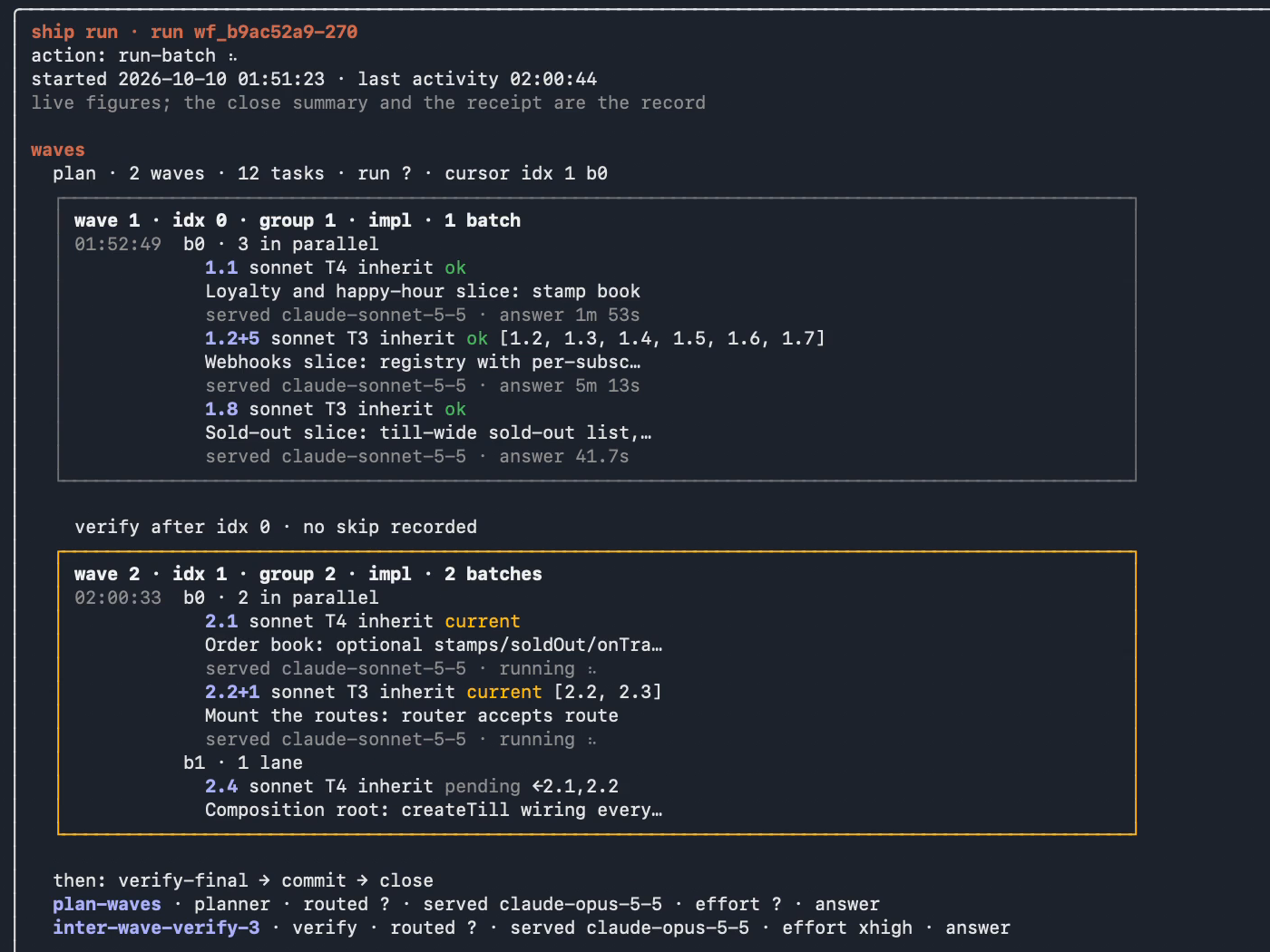
The same run, drawn inside Claude Code while it ran: every wave, batch and lane as the CLI reported them.
On Claude Code 2.1.287 and later the plugin draws both runs live: a status line that stops at the checkpoint, a pane of every wave, lane and agent, and each degradation banner as a toast the moment it is raised. The pane observes; the CLI decides. On an older host the run is the same, without the pane. The ship meter →
Turn the gates up
Default ship trusts your test suite: a green suite, one commit, nothing else. None of the rows below is needed for your first change. Add them one at a time as the loop earns it; each costs what its last column says.
| Add | What it does | Cost |
|---|---|---|
ship --review |
The review dimensions in parallel (language, architecture, qa, technical-lead, regression, and devops, security or domain when the diff calls for them), each proving what it covered, then two skeptics who must cite a file:line in the diff to dismiss anything. You see only what survived, and how many did not |
The expensive part of a run. 06 |
ship --strict |
The review, plus remediation, a manual test plan when UI changed, a walkthrough of the commit, and a conformance check of the diff against the spec's scenarios | The previous default. 01 |
/interlock:settle |
Opens or updates the PR with a MERGE, HUMAN or BLOCK verdict in its labels and description, and what would lift it. Never merges, never approves |
Needs gh or glab signed in. 15 |
interlock merge-confidence --require-merge in CI |
The same verdict as a required check. It re-reads the evidence a run left and runs no review of its own. Exits 1 unless MERGE |
Some setup. 15 |
REVIEW.md |
Your repo's own policy: paths out of review scope, paths that always need a human | One file. 12 |
Why Interlock
Most of the category competes on how much structure you write before coding: Spec Kit adds phases, BMAD adds roles, Kiro adds an IDE. Interlock competes on how many decisions the model is not allowed to make.
- Parallel agents cannot overwrite each other. The planner separates tasks that would touch the same file. With
--isolate-waves, every parallel task runs in its own git worktree and a collision is a named halt, never a lost write. - An agent cannot make the suite smaller to make it green. During remediation a hook denies test edits, task ticks and commits outside the commit stage. They are
PreToolUsehooks, inert outside a run. 13 - A dismissal needs evidence. A reviewer who says "not real" must cite a
file:linein the diff, or it dismisses nothing. 06 - Specs do not quietly rot.
interlock driftreports unarchived changes, specs citing missing files and code no spec describes, each at its own confidence, and never blocks. 03 - Degradation is spoken, never silent. A missing graph, an overridden model, a failed push: each is a named banner in the summary. 04
- Built with itself. Every feature here started as a spec and went through the same checkpoint and ship. The archive is the record, one folder per change.
| Competes on | Where the rules live | |
|---|---|---|
| Spec Kit | phases you write before code | prompt templates, portable across thirty agents |
| BMAD | roles you assign | prompt templates |
| Kiro | an IDE with specs built in | the IDE |
| OpenSpec | the artifact loop and its CLI | the CLI validates artifacts; skills run the loop |
| Interlock | how many decisions the model may not make | a CLI with exit codes, and a runtime with no channel for a question |
It composes OpenSpec rather than replacing it: /interlock:spec drives the openspec CLI, and the stock OpenSpec skills stay available for the plain artifact loop. 03 says when each is the right call; 08 sets the harness beside OpenClaw, Hermes Agent and DeepSeek Harness. The trade is portability: Claude Code is the default and supported host, and Cursor and Copilot are not supported, because the guarantees come from Claude Code's workflow runtime.
Fine print: other hosts, the network, and the CLIs on their own
Other hosts (experimental). interlock-run drives the same loop over the Claude Code CLI, any Agent Client Protocol (ACP) agent, OpenAI Codex or Qwen Code. You start it yourself; no slash command does, and /interlock:ship never falls back to it. Two caveats, both bannered by the runner. claude -p, the Agent SDK and ACP are the usage Anthropic flagged for separate metered credit, while the Workflow runtime behind /interlock:ship is the exempted path. And Codex and Qwen need the planner's model tiers mapped with INTERLOCK_MODEL_MAP; an unmapped tier is bannered, never silently run on your default. The older interlock-ship-acp still works, prints a deprecation line, and is removed in the next minor. Code Mode is out of scope. Host table, banners and configuration: 07.
The network. Everything runs without a model and without the network, with one opt-in exception: interlock notify pushes one message, so a run or a checkpoint reached while nobody was watching can still reach you.
- What is sent.
run close --notifysends the close summary's first line, the change name and the run id. The spec checkpoint sends the change name. Aninterlock notifyyou type sends the title and body you give it. - Where it goes. To the ntfy server named by the plugin's
ntfy serveroption or byINTERLOCK_NTFY_URL(the publichttps://ntfy.shby default), under the topic in the plugin'sntfy topicoption orINTERLOCK_NTFY_TOPIC. With no topic set, no request is ever made. - What identifies you. No account, key or token goes with the request. The topic is the only thing in it that identifies you, so treat it as a secret.
- How an option reaches the CLI. A plugin option reaches hooks only, so each option has a session-start hook of its own, which the host runs only when that option is saved, and it writes the matching variable into the session's environment unless you already set it.
- Requests that belong to other tools.
/interlock:settlehas the model rungh,glabandgit fetchunder your own sign-in; those requests are those tools'.interlock doctorreports whetherANTHROPIC_API_KEYorCLAUDE_CODE_OAUTH_TOKENis set, by name and never by value. The vendor CLIs a run spawns inherit the environment as any child process does; what they send is theirs.
Interlock makes no other request.
The CLIs on their own. interlock (the policy engine), interlock-graph (a local, deterministic code graph; no vector store, no network) and interlock-run (the runner above) are three zero-dependency Node binaries. The plugin puts them on Claude Code's PATH; npm install -g @renzrollon/interlock puts them on yours. Every gating subcommand exits 1 when it blocks. Reference and every environment variable: 07.
Docs
New here? Start with 01 — The first hour, and keep 04 — When it stops open during your first ship. Only ever prompted a coding agent? 09 defines every term once, ending at why ship is a script and not a prompt.
| 01 — The first hour | Install to first shipped change |
| 02 — The checkpoint | How to read a spec in ten minutes |
| 03 — OpenSpec vs Interlock | What composes with what |
| 04 — When it stops | Every halt and banner, and what to do |
| 05 — Continuity | When --continue may skip the human read |
| 06 — Why it works | The mechanisms, low-level, with the costs stated |
| 07 — CLI and configuration | Every subcommand, environment variable and host |
| 08 — The Interlock harness | The parts of the harness, what holds on each host, and a short comparison with other harnesses |
| 09 — From prompt to workflow | New to agentic workflows? Every term defined, then why ship is a script |
| 10 — Ship and spec for prompt-only engineers | Primer, review of spec+ship, token and quality tactics |
| 11 — The indicators | What interlock report measures and why it gates nothing; whether to commit the run corpora |
| 12 — Repository review policy | The optional REVIEW.md: what it can change and what it cannot |
| 13 — The guards | The hooks, the stage marker's lifecycle, and the fail-open rule |
| 14 — Evals | What a consumer's run is checked by, why no model evals run in your CI, how to file a failure |
| 15 — Merge confidence | What the MERGE / HUMAN / BLOCK verdict reads, signal by signal, and how it reaches a pull request or a CI job |
| 16 — Upgrading | What an upgrade keeps, what a resume across versions does, and how to keep the CLI at the plugin's version |
Development
git clone https://github.com/renzrollon/interlock && cd interlock
npm test                      # no dependencies to install first
claude --plugin-dir .         # load it without installing
More in CONTRIBUTING.md. Report vulnerabilities privately (SECURITY.md); ACCESSIBILITY.md and the code of conduct cover the rest. Built on OpenSpec by Fission AI, and on the wave-execution pattern for parallel task application. MIT.