DSH Better Reasoning Effort





English | 中文
Reasoning-effort and input-modality editing for third-party models in DeepSeek Harness, edited right inside the official Models page card — plus a quick reasoning-effort slider inside the official composer model menu (adapted from HanaAyane's dsh-reasoning-effort, see Acknowledgements).
Why
The llm-pi-ai adapter natively supports per-model reasoningEfforts and input declarations, but the official Models page editor deliberately keeps both fields out of reach. As a result, third-party models get no thinking-level picker in the composer, only the official DeepSeek API can set reasoning effort, hand-declared models are treated as text-only, and configuring any of this meant hand-writing settings.yaml blocks. This plugin brings both configuration surfaces back into the UI: edit inside the official model editor card, plus one-click auto-adapt.
Features
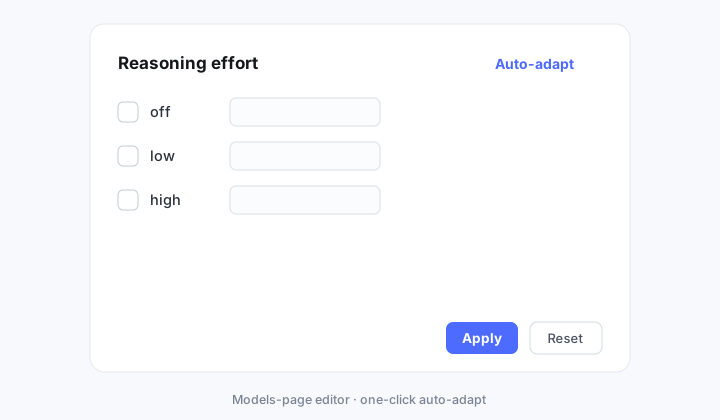
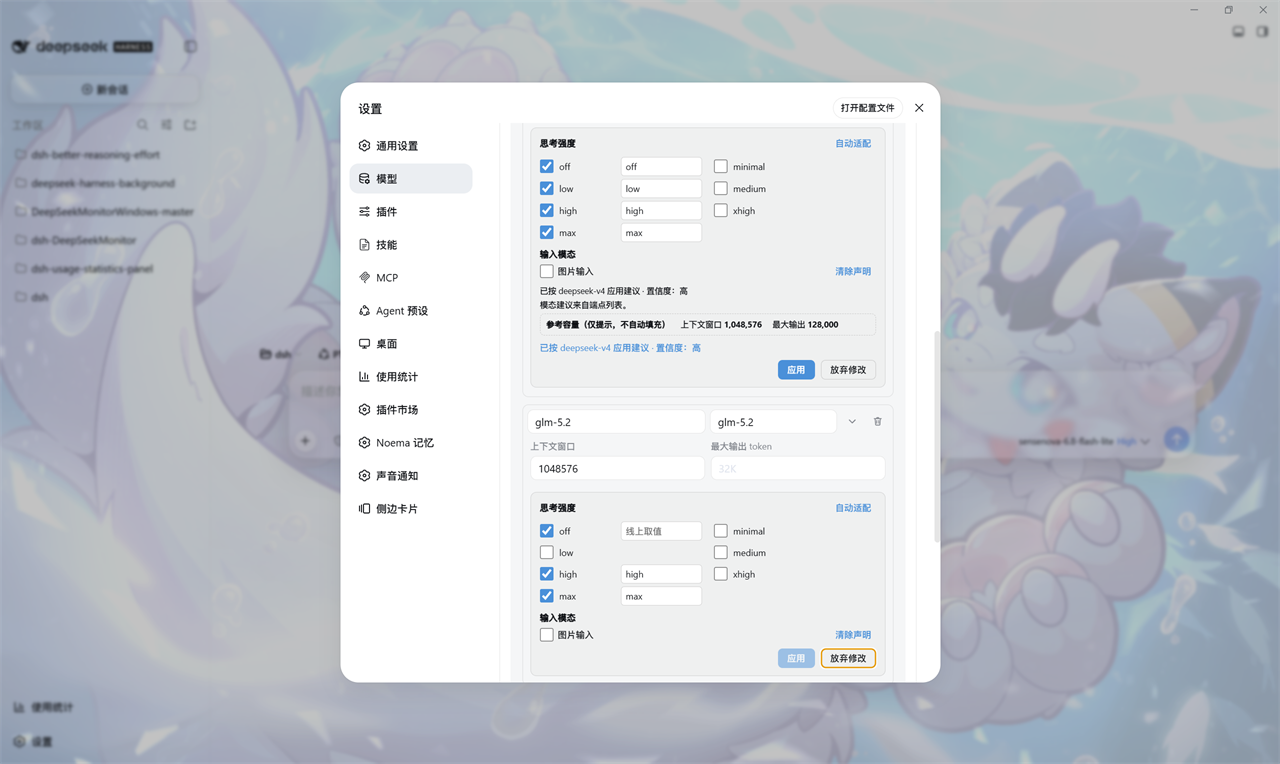
- In-page editor — an "Options" block appears under each model row's disclosure on the official Models page (reasoning effort, input modalities, endpoint compatibility), committing with the card's own Save; changes stay pending until then, and Cancel discards them with the card's fields.
- Auto-adapt — one click fills recommended levels, wire spellings and modalities from a built-in knowledge base (65 entries across 15 vendors — see Supported models), wire-protocol inference, and a same-origin probe of the provider's raw
/modelslisting, every suggestion labeled by confidence; reference capacities show as read-only hints you copy yourself. - Auto-fill — models without a declaration are filled at boot and when added mid-session (opt out via
autofill: false/modalityAutofill: false); explicit declarations,falseand deliberately-unset markers are never touched. - Three intents — all levels off = unset (back to inheritance); only
off= disable reasoning; levels armed = write the declaration. - Composer slider — the official model menu's body is replaced by an upstream-style effort slider (drag / keyboard, optimistic commit with rollback), with one model row opening the official model list; the official trigger stays untouched, and model switches keep your level through a per-session memory chain (issue #4's per-model default effort outranks it across sessions).
- Per-model default effort — a "Default effort" picker on each model row, stored in the settings document; every new session starts the model there.
- Request headers &
user-agent— a provider-card section edits the officialheadersfield (masked, path-merged, Save-gated), and the plugin performs theuser-agentoverride at the fetch layer per origin, because the official adapter reserves that name; same-origin/modelsprobes are covered, conflicts are reported rather than guessed. - Defensive injection — everything keys off the official page's DOM; if an official upgrade changes the structure, injection simply pauses and the official page is unaffected.
- Bilingual copy (中文 / English).
Supported models
The auto-adapt knowledge base carries 65 curated entries across 15 vendors (DeepSeek, OpenAI, Anthropic Claude, Gemini, Grok, Qwen, GLM, Kimi, Mistral, MiniMax, MiMo, Doubao, Hunyuan, Step, ERNIE — re-verified against official docs 2026-08/09, including vision-capable variants and no-effort-control families). The full table — match patterns, level → wire-spelling ladders, defaults, modalities, reference capacities — lives in docs/supported-models.md (generated from src/knowledge.ts, the authoritative source). Unlisted models fall back to protocol inference + generic levels, adjustable by hand.
Install
Requires DeepSeek Harness 0.1.5-alpha.1 or later (per-line peer ranges; the 0.1.2-rc / 0.1.3-alpha lines are no longer supported — use plugin 0.3.7 there). Compiled and gated against 0.2.0-rc.2. The per-kernel seam re-checks behind this live in docs/compatibility-notes.md.
From npm, under the dsh web profile:
dsh plugin --profile web add dsh-better-reasoning-effort
DSH bundles pnpm 11.7.0, whose default minimum-release-age is 24 hours: an install started within a day of a release resolves to the newest version old enough and installs that one, while the plugin manager may still display the newer release. Name the version to install it without waiting — pnpm accepts a named version and records it as an exemption:
dsh plugin --profile web add dsh-better-reasoning-effort@0.5.2
The release page also carries the packed tarball, which skips both the registry and the release-age wait. It is prebuilt, so pnpm executes nothing and asks for no build approval. The URL names one version, so an update replaces it:
dsh plugin --profile web add \
  https://github.com/HaoyueQin/dsh-better-reasoning-effort/releases/download/v<version>/dsh-better-reasoning-effort-<version>.tgz
From GitHub source, for development and review rather than normal installs. pnpm runs the prepare hook to build lib/, and allows that only once an allowBuilds entry exists. The installer prints the exact key, which names the resolved commit: add it to the profile's pnpm-workspace.yaml and repeat the add. A new commit changes that key, so every release needs re-approval, and the commit-free key form needs a newer pnpm than the bundled 11.7.0:
dsh plugin --profile web add github:HaoyueQin/dsh-better-reasoning-effort
Or link a local checkout for development:
npm install && npm run build
dsh plugin --profile web add link:D:/Project/dsh-better-reasoning-effort
Restart dsh web and hard-refresh the browser.
Usage
- Configure a third-party provider (API key etc.) on the official Models page.
- Expand a model row: the editor block sits under the official capacity fields.
- Check levels (off / minimal / low / medium / high / xhigh / max) and fill the wire values (e.g. give
highthe spellingultra, and the gateway receivesultrawhen you pick High in the composer); - Toggle Image input under Input modalities to declare what the model accepts;
- Click Auto-adapt to fill recommended levels and modalities — reference capacities show up as read-only hints you copy into the official fields yourself;
- Any change is pending and lands when you press the card's own Save; Cancel (or a reload) discards it with the card's fields.
- Check levels (off / minimal / low / medium / high / xhigh / max) and fill the wire values (e.g. give
- On a compatible protocol, the Endpoint compatibility section appears at the bottom — thinking budget field / vLLM priority on
openai-completions,max_output_tokenshandling onopenai-responses. - All levels off + Save = unset the declaration; only
offchecked + Save = disable reasoning (false); Clear declaration + Save = back to inheriting the provider default.
Declared models are immediately selectable for reasoning effort in the composer, and image-declared models accept attachments end to end.
Configuration
Optional on the plugin's profile row (values shown are the defaults):
- insert:
    - id: dsh-better-reasoning-effort
      name: dsh-better-reasoning-effort
      config:
        autofill: true          # auto-fill undeclared models at boot
        modalityAutofill: true  # whether the boot fill also covers modalities
        probeTimeoutMs: 15000   # /models probe fetch timeout
        bootRetryDelaysMs: [1000, 2000, 4000, 8000, 16000, 30000]
        defaultGuard: true      # map effort-less calls on forced-thinking
                                # ladders to the vendor default
How it works
Browser (lib/client.js)                  Host (lib/index.js)
├─ DOM injector                          └─ Auto-fill
│   MutationObserver on the models page      settings/document-updated →
│   → mounts EffortEditor in each            invalidates the host cache;
│     model row's disclosure                 browser idle pass fills models
├─ Composer injection
│   MutationObserver on the document
│   → ComposerSlider (root pane)
├─ EffortEditor (React component)             (knowledge base + inference)
│   level checkboxes / wire values /
│   input-modality toggle /
│   auto-adapt (zoned suggestions) / committed with the card's Save
│   └─ writes settings.mutate (llm-pi-ai)
suggestEfforts()insrc/knowledge.tsis the knowledge base + inference engine — a pure function shared by host and browser.reconcile()insrc/client/injection/models-page-editor.tslocates model rows and mounts the editor;src/client/index.tsassembles the browser half, one module per seam insrc/client/injection/.createEditorApi()insrc/client/ops.tswrites the declarations viasettings.mutate, preserving every other row field and retrying once on a revision conflict.
Development
npm run typecheck   # tsc strict check on src
npm test            # vitest: knowledge / inference / autofill / DOM injection / writing
npm run build       # lib/*.js + lib/client.js (module-loader bundle)
Compiled and gated against the 0.2.0-rc.2 official packages; see docs/compatibility-notes.md for the per-kernel records.
Known limitations
- Injection depends on the official Models page's DOM (aria-label/class); an official upgrade may pause injection until adapted — the official page is unaffected meanwhile.
- The auto-adapt probe route answers loopback and IP-literal hosts only (the core
/apiHost-allowlist discipline withouttrustedHosts), and never follows redirects — a gateway listing its models only behind a 30x simply yields no endpoint evidence; Auto-adapt falls back to the knowledge base and protocol inference. reasoningEffortsdeclarations are suggestions — what an endpoint actually accepts is up to its docs; tweak in the UI. The knowledge base is not exhaustive; families without an effort ladder carry no entry at all.- Endpoint-compatibility switches are never auto-filled by design: they describe a gateway, not a model.
- The modality vocabulary follows pi-ai's core (
text/imagetoday); wider gateway support (PDF, audio, video) is recorded per family until the core vocabulary grows. - Name-heuristic modality advice (vision-flavored ids) is deliberately low-confidence and labeled as such.
- Self-hosted relays: auto-fill pins
supportsDeveloperRole: falseon routes no official host claims (some upstreams reject thedeveloperrole); explicit values are never overwritten. - Forced-thinking models (ladders without
off, e.g. GLM-5.3): effort-less calls map to the vendor default instead of sendingthinking: disabled— setdefaultGuard: falseto restore raw behavior. - Credentials inside
headersare not redacted on disk: the read-only view masks them, but the settings document still holds them in clear text — treat it like an API key. - The request-header section's edit-state detection reads an unofficial signal (the official row exposes no data attribute for its editor state); if an official build renames that class root, the section stops appearing — never breaking the page.
- Only one
user-agentrewrite should be active: sibling header plugins land on the same layer; the plugin detects and reports known ones, but the last writer on the wire wins. - The request-layer takeover relies on the official adapter creating a fresh SDK client per request — guarded by an end-to-end test that fails loudly if that changes.
Acknowledgements
The composer slider is adapted from dsh-reasoning-effort by HanaAyane (MIT) — thank you for the original work and the codex-style effort control idea. This integration keeps the upstream session-selection contract and slider interaction, with deliberate changes: a white round thumb only (no chibi-runner knob), the official model seat never replaced, and placement on the 0.1.5-alpha+ line as a reduced re-implementation over the harness wire contract. If you used the upstream plugin, remove it to avoid two effort controls on the same seat:
dsh plugin --profile web remove dsh-reasoning-effort
Activity

License
MIT