StarAgent
⚠️ This project is currently intended for personal use and is under active development. A stable version will be released later.
⚠️ This project was primarily built with vibe coding and may contain potential bugs. Please keep this in mind before using it.
StarAgent is a local-first Agent Harness Launcher and an optional multi-Node Hub for managing coding agent sessions. It reflects my own best practices for using multiple agents:
We need a lightweight persistent terminal wrapper for Codex / Claude Code that supports cross-machine connections and can be accessed from any device.
Design Principles
It is built around a few practical needs that show up when using coding agents day to day:
- We often run multiple agent CLI instances in parallel across different working directories, each handling a separate task. We need one place to check their status and interact with them in real time.
- We want to interact with our agents anywhere, anytime, and on any device. And the sessions should be consistent.
- Agent CLI sessions should be long-lived, so we do not need to keep typing
/resume.
Based on hands-on experience, StarAgent uses the simplest effective stack for this workflow, making it feel like managing a small team of coding agents:
Platform-native persistent terminals. Windows Desktop hosts sessions with ConPTY; Linux, macOS, and server Nodes use long-lived tmux sessions. See SESSIONS.md for the session model.
Cross-machine connectivity via Tailscale. Tailscale provides a secure and unified network layer across machines. See tailscale/README.md for the Tailscale setup.
Unified management through a web dashboard. The web dashboard lets you control agents from any device with a browser, including phones and laptops, without installing extra software.
Node-local account and launch control. Sign in or switch credential sources from the Harness page, browse the models exposed by each CLI, and choose model plus reasoning-effort defaults for new Sessions without rewriting vendor configuration files.
Running staragent opens the single-Node StarAgent Launcher, scoped directly to the current machine. When cross-machine management is needed, staragent hub keeps the existing Hub experience: choose a Node, then enter the same Node workspace used by Launcher.
For the technical architecture, see ARCHITECTURE.md.
Preview
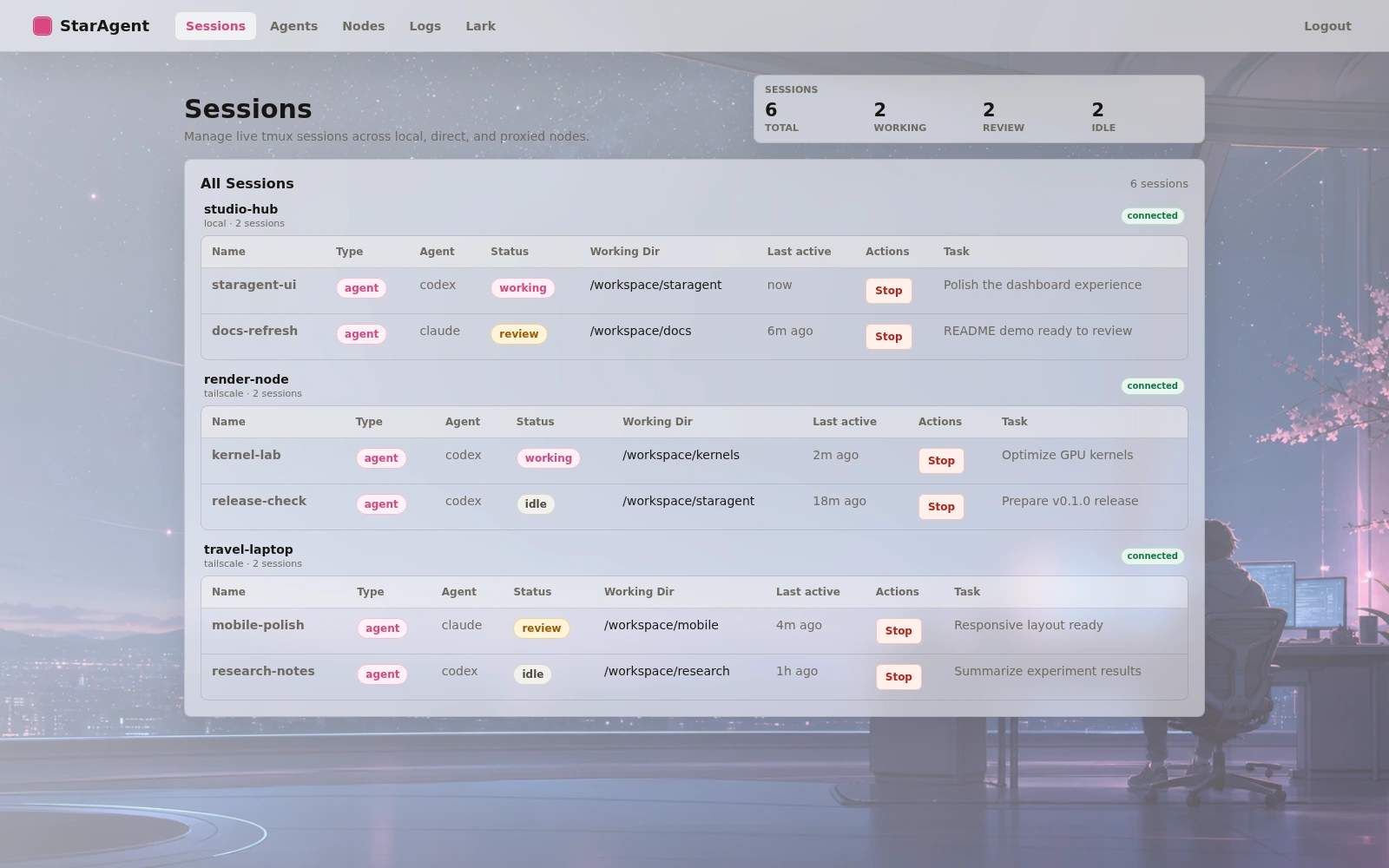
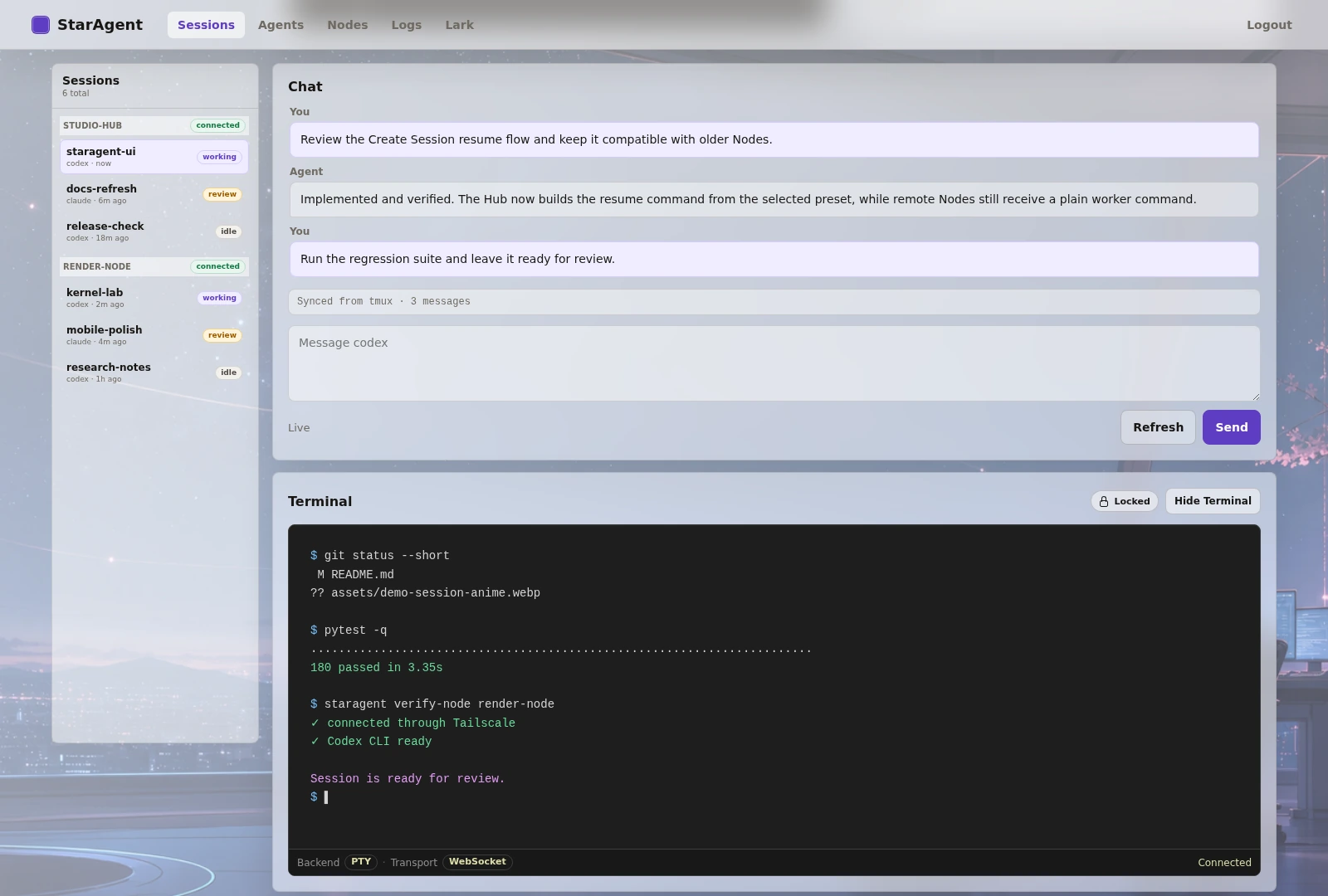
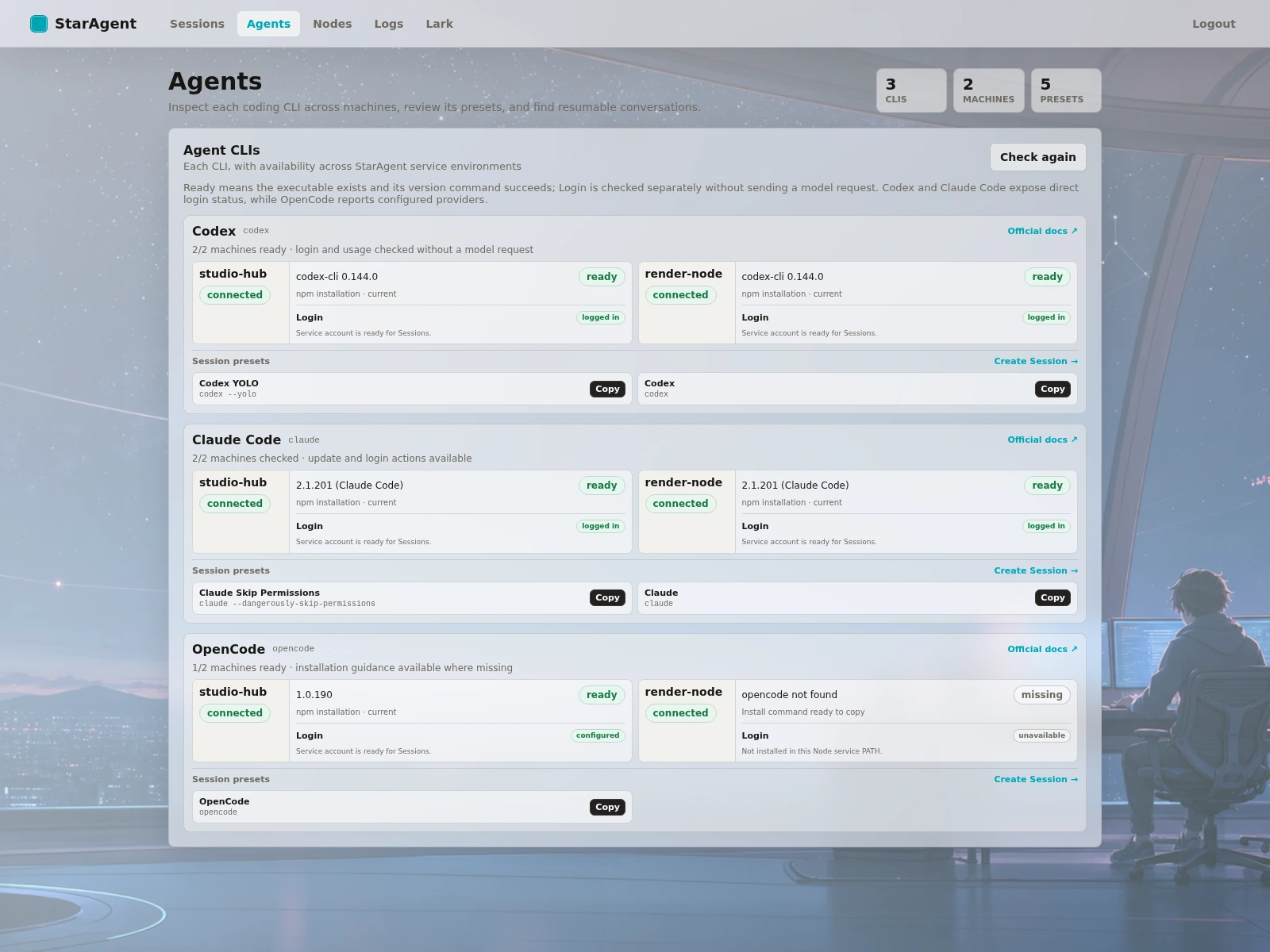
The screenshots below use sanitized demo data. The anime-inspired background is optional — upload any image from the theme menu, then pair it with a color theme and glass surfaces.
Select a connected Node, then manage that machine's sessions in a focused workspace:
Each session includes a lightweight chat console for interacting with agents, plus a Terminal and File Explorer. Session detail pages keep an IM-style switcher on the left for moving between that Node's sessions without returning to the session table; on narrow screens it collapses into a drawer.
Inspect Agent CLI availability, login state, installed Skills, streamlined install/update paths, and launch presets on the selected Node:
NOTICE: Source-installed Linux/macOS Nodes keep their SSH-friendly tmux backend. Self-contained Desktop packages instead own native PTY Sessions (ConPTY on Windows). In both cases, closing a browser or workspace view only detaches the view; it does not stop the Agent Session.
Launcher
Install from a checkout, then start StarAgent with no subcommand:
pip install -e .
staragent
Launcher starts in the supervised staragent-launcher tmux system session and opens the local
Harness workspace at http://127.0.0.1:8080. Under SSH it prints the URL without trying to open a
browser. Use staragent --no-open to explicitly disable browser handoff.
Launcher is the normal single-machine experience. It opens directly on the local Agents catalog; Sessions, Logs, Settings, and Current Node details use the same views as a Node selected in Hub. Current Node also reports the terminal, networking, and package-runtime dependencies on that machine and offers reviewed platform-native installation paths where available.
Desktop
A Tauri desktop app is available for Windows, Linux, and macOS. It can start the local Launcher or connect to an existing Hub. Every desktop package includes the StarAgent Python runtime and a native terminal backend: Windows uses ConPTY, while Linux and macOS use the operating system PTY API. WSL, Python, StarAgent, and tmux do not need to be installed separately.
Download a prebuilt package
Open the latest GitHub Release, expand Assets, and download the package for your system:
| System | Release asset | Install |
|---|---|---|
| Windows x64 | *-setup.exe |
Run the per-user installer |
| Linux x64 | *.AppImage |
Make it executable and run it |
| Debian / Ubuntu x64 | *.deb |
Run sudo apt install ./<downloaded-file>.deb |
| macOS Apple Silicon | *_aarch64.dmg |
Open the DMG and drag StarAgent to Applications |
| macOS Intel | *_x64.dmg |
Open the DMG and drag StarAgent to Applications |
Do not confuse GitHub's automatically generated Source code archives with desktop installers. If
a release contains only those archives, it predates desktop packaging; use a newer release, a CI
artifact, or the source installation above. v0.1.1 and earlier do not contain desktop installers.
Updater-enabled desktop releases offer Stable and Nightly channels and check the selected one
at startup. Stable follows normal Releases; Nightly follows signed builds from relevant dev commits.
A prompt shows the version, source commit, and release notes, and installation only starts after you
confirm Update & restart. If your current installation predates the updater, install the first
updater-enabled release manually once.
The same files can be downloaded with the GitHub CLI:
# Linux example; use '*.deb', '*_aarch64.dmg', or '*_x64.dmg' as appropriate.
gh release download --repo SiriusNEO/StarAgent --pattern '*.AppImage'
For an unreleased development build, select Nightly in the app. Individual build artifacts remain in
the Desktop workflow as
staragent-windows-x64, staragent-linux-x64, staragent-macos-arm64, and
staragent-macos-x64; GitHub requires sign-in to download workflow artifacts directly.
Release updater payloads carry a Tauri update signature, while operating-system publisher signing is still pending and may show an unknown-publisher warning. Local mode is self-contained on all three platforms. Agent Harness CLIs remain optional and can be installed from the Agents page; npm and China-friendly mirrors remain explicit fallbacks for systems that already provide npm. See DESKTOP.md for runtime details, updates, native builds, and signing status.
Hub
Run this on the machine that runs the dashboard:
pip install -e .
staragent hub --host 0.0.0.0 --port 8080
staragent hub creates the staragent-hub tmux system session by default.
Open http://<hub-node>:8080 and log in with the token printed by staragent hub.
See HUB.md for authentication and state settings, Dashboard surfaces, centralized logs, runtime dependencies, Agent CLI checks, China-friendly install sources, updates, usage reporting, presets, and conversation resume behavior.
Remote Node
Run this on each machine that should run agent sessions:
pip install -e '.[dev]'
export STARAGENT_NODE_TOKEN="<same token as the Hub>"
sudo tailscale up --ssh
staragent node-ts --sudo
staragent node-ts checks that Tailscale is installed and already connected, then
starts the staragent-node tmux system session and configures tailscale serve.
If Tailscale is not ready, it prints the tailscale up --ssh command to run first.
Use --sudo when tailscale serve requires root privileges.
For LAN or another network layer that does not need tailscale serve, use:
staragent node
Before adding the Node, verify it from the Hub machine:
staragent verify-node <node-host-or-100.x-ip>
Add the reachable Host and Port in the Hub dashboard, for example 100.x.x.x and 8081.
If the Node uses a non-default port, enter that port explicitly, for example 8082.
Acknowledgements
StarAgent's CLI transcript parsing is adapted from ideas and code in botmux. The Launcher's local-browser, SSH, and --no-open startup behavior is inspired by DeepSeek Harness. Its focused source picker and single-primary-action installation flow draw inspiration from HMCL. The dashboard visual style is inspired by the Tailscale admin console. Markdown preview follows GitHub Flavored Markdown conventions. The web terminal uses xterm.js, and file preview highlighting uses highlight.js.
License
MIT. See LICENSE.