Haven
A household agent for Alexa+ that understands what the home is trying to do, makes a plan, acts, and checks its work.
Smart homes understand commands. Haven understands situations.
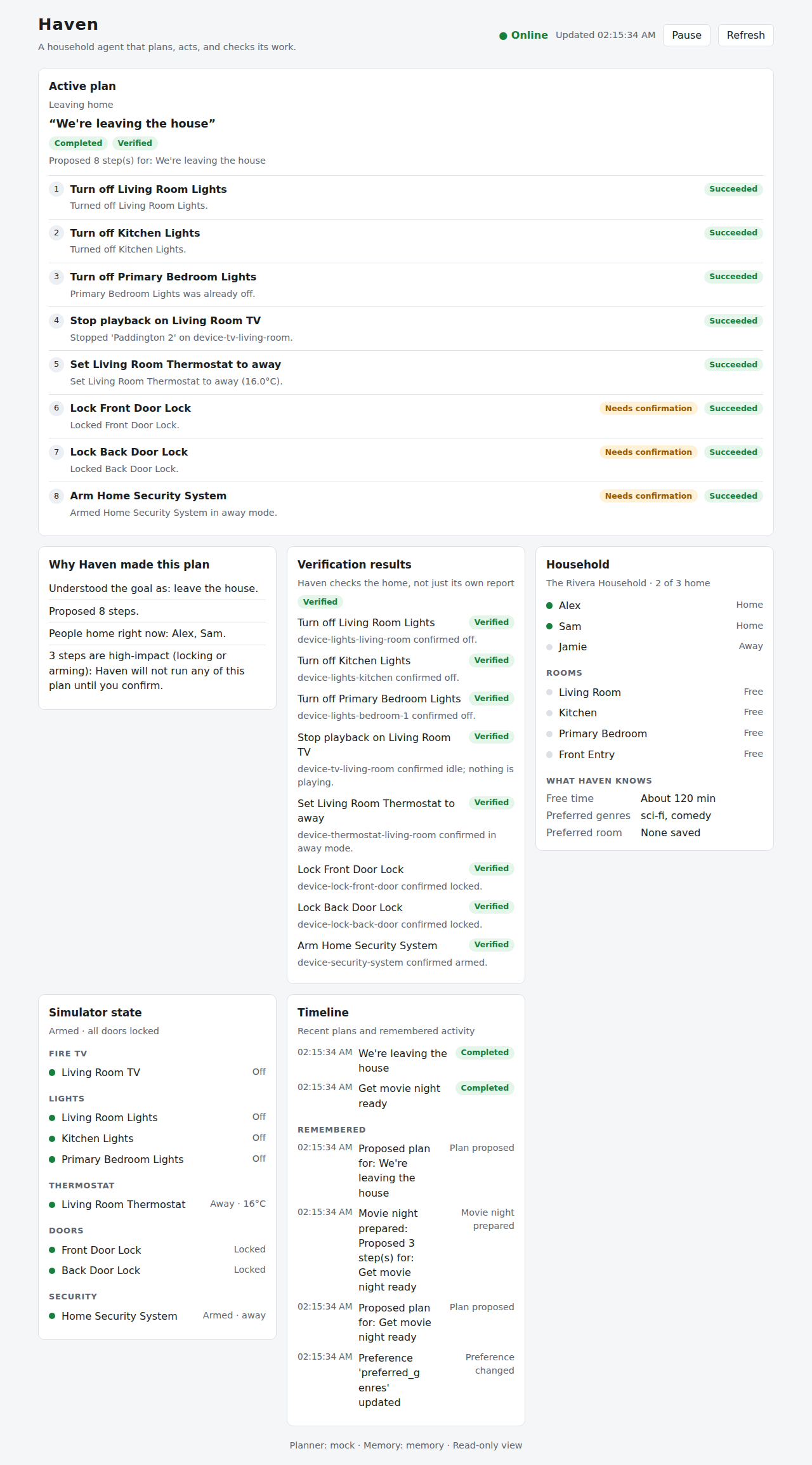
Haven's dashboard after "We're leaving the house" is confirmed: eight steps ran, and Haven re-read the home to verify each one. (Rendered from the real components with real backend data; see the demo.)
What is Haven?
Say "we're leaving the house" and a normal smart home needs eight separate commands. Haven takes the goal: it works out who is home, what is on, and what could go wrong; proposes a plan; asks before doing anything it can't easily undo; runs it; then re-reads the home to confirm each step really took effect, retrying once if a device didn't listen. If it can't plan safely, it asks a question instead of guessing.
It is built for the Amazon Developer Hackathon: Alexa+ is the interface, Haven is an MCP server Alexa+ calls, and it runs on AWS.
Three workflows
| Say | Haven does | Asks first? |
|---|---|---|
| "Get movie night ready" | Picks a film that fits the free time, queues it on the TV, dims the lights, verifies | No — all reversible |
| "We're leaving the house" | Lights off, stops the TV, thermostat to away, locks both doors, arms security, verifies each | Yes — locking and arming |
| "What should we do tonight?" | Suggests options from the calendar, saved tastes and recent activity | No — suggestions only |
How it works
flowchart LR
    U([User]) --> A[Alexa+]
    A -- "MCP (Streamable HTTP)" --> G[Bedrock AgentCore<br/>Cognito JWT]
    G --> H

    subgraph H [Haven]
      direction TB
      C[Context<br/>resolver] --> P[Planner]
      P --> E[Executor]
      E --> V[Verifier +<br/>recovery]
    end

    P -. plans .-> B[(Amazon Bedrock)]
    H -- memory --> D[(DynamoDB)]
    E --> S[Simulated home<br/>lights · thermostat · locks · Fire TV]
- Context — gathers only what the goal needs, from approved sources (what you said, the calendar, device state, simple sensors, saved preferences). It asks rather than guesses.
- Plan — deterministic code applies hard constraints (time, availability, capabilities); the model, when enabled, only chooses and explains among what is left. Every step is labelled reversible or high-impact.
- Execute — plain code, never the model. High-impact steps run only after explicit confirmation.
- Verify — Haven reads the home back. A step that didn't take effect is retried once, then reported honestly.
More: MCP interface · Architecture · Privacy.
Why these technologies
- Alexa+ gives a natural-language front door, so the user states a goal and Haven turns it into actions.
- MCP is the contract: six small tools (context, propose, status,
execute, save preference, recommend) that Alexa+ can call, with JSON
Schemas in
apps/alexa/schemas/. - Amazon Bedrock AgentCore hosts the MCP server (stateless Streamable HTTP) behind a Cognito JWT authorizer.
- Amazon Bedrock (via Strands Agents) does the planning when
HAVEN_PLANNER_BACKEND=bedrock; a deterministic mock planner is the offline default and is what the tests use. - DynamoDB stores preferences, remembered activity and proposed plans
(
HavenPreferences,HavenActivities,HavenPlans), reached through least-privilege IAM policies inaws/iam/policies/.
See AWS and Deployment for the cloud side.
Try it (offline, no AWS account)
Requires Python 3.11+.
pip install -e ".[dev]"

pytest                               # the full offline test suite
python scripts/run_movie_night.py    # context → plan → execute → verify, narrated
python scripts/verify_demo.py        # rehearse every beat of the demo
Run the server and the dashboard:
python scripts/run_server.py --dashboard-api     # MCP at http://127.0.0.1:8787/mcp
cd apps/dashboard && npm install && npm run dev  # http://localhost:5173
Point the MCP Inspector
(npx @modelcontextprotocol/inspector) at http://127.0.0.1:8787/mcp, call
propose_household_plan_tool with goal: "we're leaving the house", then
execute_household_plan_tool with the returned plan_id — first without
confirmed, then with confirmed: true — and watch the dashboard.
To use it from Alexa+ see apps/alexa/README.md.
Reproduce the demo
Follow docs/demo.md: the three-minute script, the setup, the fallbacks if something misbehaves, and the questions to expect.
Configuration
Copy .env.example to .env (it is git-ignored). Everything defaults to
offline.
| Variable | Default | Purpose |
|---|---|---|
HAVEN_PLANNER_BACKEND |
mock |
mock (offline, deterministic) or bedrock |
HAVEN_PERSISTENCE_BACKEND |
memory |
memory or dynamodb |
HAVEN_MAX_PLAN_STEPS |
12 |
Safety cap on plan size |
HAVEN_LOG_LEVEL |
INFO |
Log verbosity |
HAVEN_MCP_HOST / HAVEN_MCP_PORT |
127.0.0.1 / 8787 |
Where run_server.py binds |
HAVEN_DASHBOARD_API |
off | Serve the dashboard's read-only JSON (--dashboard-api) |
AWS_PROFILE, AWS_REGION |
— | Only for Bedrock / DynamoDB; standard credential chain, never committed |
Bedrock model settings are in .env.example.
Repository tour
src/haven/
  context/        Context resolver: sources, facts, expiry
  planning/       Constraints, workflow recognition, plan service
  agents/         Planner, prompts, policies (reversible vs high-impact), Bedrock reasoner
  execution/      Deterministic action handlers and the executor
  verification/   Verifier and the recovery pass
  integrations/   Calendar, media, home, security (simulator-backed)
  memory/         Preferences and activity, in memory or DynamoDB
  mcp/            The MCP server, tools, schemas, dashboard API
aws/              Bedrock client, DynamoDB tables, IAM policies, AgentCore runtime
simulator/        The simulated home: household, media, security/devices
apps/alexa/       Alexa+ add-on config, tool catalog, JSON Schemas
apps/dashboard/   React dashboard (read-only)
scripts/          Server, demo rehearsal, submission check, schema export, tooling
tests/            unit · workflows · integration · fixtures
docs/             mcp · privacy · testing · demo · submission · friction log (+ AWS docs)
Documentation
| docs/mcp.md | Every tool, the plan lifecycle, confirmation and state |
| docs/privacy.md | What Haven collects, remembers and refuses |
| docs/testing.md | Test layers, fixtures, failure scenarios, CI |
| docs/demo.md | The three-minute demo and how to reproduce it |
| docs/architecture.md | How the pieces fit |
| docs/aws.md · docs/deployment.md | The AWS services and how Haven is deployed |
| docs/submission.md | Hackathon submission text and product feedback |
| docs/friction-log.md | What was hard, per tool |
| CONTRIBUTING.md | Setup, style, how to add a tool or a workflow |
Safety and privacy in one paragraph
Camera-free: Haven has no camera or microphone code. It gathers the minimum context a goal needs, never turns temporary state (who is home, what is locked) into memory, and asks instead of guessing. Locking and arming need explicit confirmation, enforced by the planner, the executor and the tool. The deployed runtime sits behind a Cognito JWT authorizer. Limits, stated plainly: Haven trusts Alexa+ that the user really confirmed (it doesn't identify the speaker), models one household, has no "forget this" tool yet, and a local server has no authentication. Details in docs/privacy.md.
Status
What is built and tested: the three workflows end to end against a simulated home, the MCP server and its six tools, confirmation gating, verification and recovery, the dashboard, the AWS integrations, and the AgentCore runtime behind Cognito. What is not confirmed: Alexa+ calling the deployed runtime end to end (how Alexa+ presents the Cognito token, and the add-on manifest format, were not checked against a live Alexa+ account), and the home is simulated rather than real devices. See the friction log.
What's next
- Confirm the Alexa+ add-on manifest and token flow against a live account.
- Real Ring / Fire TV integrations behind the existing interfaces.
- Persist execution results alongside plans so status survives across instances.
- A "forget this" tool, and expiry on stored history.
- Per-person authorization for confirmations.
- Proactive suggestions ("it's Friday and everyone's home — movie night?").
Contributing
Issues and pull requests are welcome; see CONTRIBUTING.md. Haven is licensed under the Apache License 2.0.