SMC Reader
Save My Context Reader — keep large tool outputs out of your agent's context window.



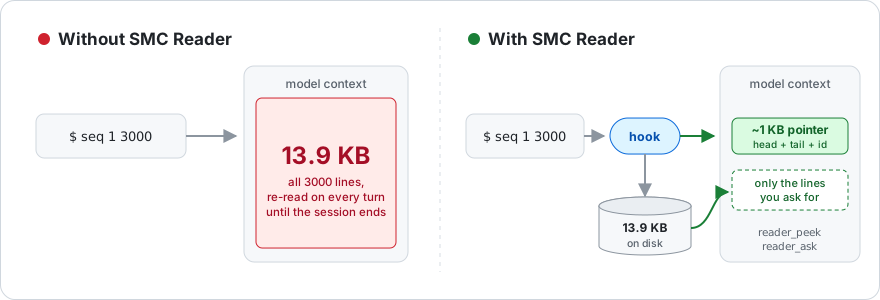
A big Bash or WebFetch output does not have to land in the model's context.
SMC Reader's hook catches it before the model sees it, spills it to disk and hands the model a
short pointer. The model then pulls only what it needs — exact lines, or an answer to a question.
Quick start
In Claude Code (Node.js ≥ 20 on PATH):
/plugin marketplace add bulatko/SMCReader
/plugin install smcreader@smcreader
That's it — no settings.json or --mcp-config edits. Run something noisy and the model gets this
instead of 3000 lines:
[READER ctx_b4c9b23c] Bash output intercepted: 13893 bytes, 3001 lines (>2048 chars).
1
2
...
... (2989 lines omitted — in the reader) ...
2999
3000
Full output is in reader ctx_b4c9b23c: mcp__plugin_smcreader_smcreader__reader_ask(id, question) to analyze, mcp__plugin_smcreader_smcreader__reader_peek(id, start_line, end_line) for exact lines, mcp__plugin_smcreader_smcreader__reader_close(id) when done.
Why
Agents run commands whose output is mostly noise for the task at hand: test logs, build output,
grep -r, git log, fetched pages. Every byte of it stays in the context for the rest of the
session, pushes out what matters and makes every following turn more expensive.
Truncating is not a fix — the one line the agent needs may be in the middle.
Measured on our own agent transcripts over 5 days (19–23 Oct 2026): 472 interceptions, 2.88 MB of tool output.
| what the agent did with the intercepted output | share |
|---|---|
| nothing — the head and tail in the pointer were enough | 48% |
asked a question (reader_ask) |
11% |
pulled a part of it (reader_peek) |
14% |
| pulled almost everything back | 27% |
54% of the intercepted bytes (1.55 MB) never entered the context. On outputs of 16 KB and more the saving is about 21 KB per interception.
How it works
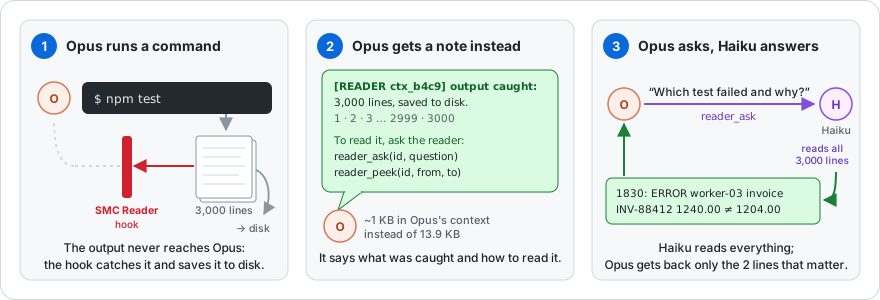
The main model (Opus, Fable) runs a command as usual — but the output never reaches it. SMC Reader's
hook catches it on the way, saves it to disk and gives the model a short note instead: what was caught
and how to read it. When the model needs something, it asks a cheap model (Haiku) with reader_ask;
Haiku reads the whole output and returns only the lines that answer the question, verbatim.
Exact lines by number (reader_peek) come straight from disk, with no model at all.
Under the hood:
- Claude Code runs a tool and passes the result to the
PostToolUsecommand hook. - If the output is large (≥ 2048 chars by default), the hook writes it to
~/.cache/smcreader/ctx_<id>.txtand replaces it with a pointer in the same shape as the original output — the engine silently ignores a replacement of a different shape. - The model sees the pointer: id, size, head and tail of the output.
- It pulls what it needs through the
smcreaderMCP server:
| tool | what it does |
|---|---|
reader_peek(id, start_line, end_line) |
exact numbered lines from disk, no LLM |
reader_ask(id, question) |
a small Haiku session reads the document and returns the relevant lines verbatim with a short note |
reader_open({path | text, briefing}) |
open any file or text explicitly |
reader_list() / reader_close(id) |
what is open / delete a document |
The hook and the MCP server are separate processes sharing one directory; the directory is the source of truth (open-document limit, LRU eviction, 48 h expiry since last use).
Install
As a plugin (recommended) — see Quick start; the repository is its own plugin
marketplace. The hook has no dependencies and runs from the plugin directory. The MCP server is
started with npx -y --omit=optional --package=smcreader@<plugin version> smcreader-mcp: the first
start downloads the npm package once (~40 MB with dependencies, ~60 MB on disk). --omit=optional
skips the Agent SDK's bundled Claude Code binaries (~280 MB per platform variant); reader_ask runs your own claude
from PATH instead (or READER_CLAUDE_EXECUTABLE). Loaded as a plugin, the tools are named
mcp__plugin_smcreader_smcreader__reader_*, and the hook writes these names into the pointer.
For a one-off session from a checkout: git clone https://github.com/bulatko/SMCReader ~/smcreader
and claude --plugin-dir ~/smcreader.
Manual setup (hook in settings.json + claude mcp add)
npm install -g smcreader # or: git clone … && npm install --omit=dev
- Hook — add to
~/.claude/settings.json(or a project's.claude/settings.json):
{
  "hooks": {
    "PostToolUse": [
      { "matcher": "Bash|WebFetch",
        "hooks": [{ "type": "command", "command": "READER_TOOL_PREFIX=mcp__smcreader__ smcreader-hook" }] }
    ]
  }
}
- MCP server:
claude mcp add smcreader -- smcreader-mcp
With a git checkout instead of a global install use node /ABSOLUTE/PATH/bin/smcreader-hook and
node /ABSOLUTE/PATH/bin/smcreader-mcp. The old binary names reader-hook / reader-mcp remain
as aliases.
Both processes read the same environment; if you set READER_DIR, set it for both
(claude mcp add smcreader -e READER_DIR=/path -- smcreader-mcp).
Intercepting an MCP tool. Add it to the hook's matcher and to READER_ALLOWLIST, e.g.
matcher Bash|WebFetch|mcp__mesh__execute and command
READER_ALLOWLIST=Bash,WebFetch,mcp__mesh__execute smcreader-hook. Never allowlist SMC Reader's
own tools.
Read guard (optional). PreToolUse, matcher Read, same command with
READER_READ_GUARD=32768: a full Read of a file above the threshold is denied with working
alternatives (Read with offset/limit, Grep, reader_open, sed/head/tail). The plugin does not
enable it.
Configuration (environment variables)
| variable | default | used by | meaning |
|---|---|---|---|
READER_DIR |
$XDG_CACHE_HOME/smcreader or ~/.cache/smcreader |
both | shared document directory |
READER_THRESHOLD |
2048 |
hook | intercept outputs of at least this many characters |
READER_ALLOWLIST |
Bash,WebFetch |
hook | comma-separated tool names to intercept |
READER_TOOL_PREFIX |
— | hook | tool-name prefix written into the pointer, e.g. mcp__smcreader__ |
READER_READ_GUARD |
0 (off) |
hook | bytes; deny a full Read of bigger files (PreToolUse) |
READER_LOG |
— | hook | append a log line per interception / error to this file |
READER_OWNER |
— | server (hook: fallback) | owner the server acts as; unset = sees all documents |
READER_ASK_FORMAT |
lines |
server | default reader_ask format: lines (verbatim lines + short note) or prose |
READER_WORK_DIR |
$TMPDIR/reader-work |
server | cwd of the Haiku reader sessions (their transcripts land there) |
READER_CLAUDE_EXECUTABLE |
the Agent SDK's bundled binary if installed, else claude on PATH |
server | Claude Code binary that runs the Haiku reader |
Owners. The hook stamps each document with the session_id from its input (a subagent's
document gets <session>/agent:<agent_id>). The open-document limit (10) and LRU eviction are per
owner; reader_close refuses another owner's document when the server has READER_OWNER;
reading by id is never restricted.
Development (layout, tests)
| path | role |
|---|---|
lib/reader-store.js |
document store over a directory (ctx_<8hex>.txt + .meta.json), owners, LRU limit, TTL sweep |
lib/reader-model.js |
Haiku reader via Agent SDK query(); answer formats prose / lines; createRunQuery({cwd, settings, cleanupPeriodDays, executable}) for embedding hosts |
lib/reader-tools.js |
transport-free tool definitions reader_open/ask/peek/close/list |
lib/intercept-hook.js |
interception: extract text, mirror the tool's output shape, build the pointer |
lib/read-guard.js |
optional PreToolUse guard for big Reads |
lib/stdio-mcp.js, bin/smcreader-mcp |
stdio MCP server (@modelcontextprotocol/sdk) |
lib/reader-mcp.js |
in-process MCP factory for the Agent SDK (createSdkMcpServer) — same tools |
lib/hook-command.js, bin/smcreader-hook |
the command hook (stdin JSON → stdout JSON) |
.claude-plugin/, hooks/hooks.json, .mcp.json |
Claude Code plugin + marketplace manifests |
e2e/claude-code.sh, e2e/plugin.sh |
end-to-end tests in a real Claude Code CLI |
npm test                                         # unit + cross-process (spawns the real bin/ scripts)
sh e2e/claude-code.sh                            # real Claude Code: hook via --settings, server via --mcp-config
READER_E2E_NO_HOOK=1 sh e2e/claude-code.sh       # negative control: no hook — must fail
sh e2e/plugin.sh                                 # real Claude Code, everything from the plugin
READER_E2E_NO_PLUGIN=1 sh e2e/plugin.sh          # negative control: no --plugin-dir — must fail
READER_E2E_PACKAGE=registry sh e2e/plugin.sh     # the published npm version instead of `npm pack`
e2e/plugin.sh loads a copy of the tracked files without node_modules (what a marketplace
install gets) and points its .mcp.json at npm pack of the working tree.
Releasing. A marketplace install takes the plugin from the default branch, and its .mcp.json
pins smcreader@<version> — so the version must be on npm before the bump reaches that branch.
Bump the version in package.json, .claude-plugin/plugin.json and .mcp.json (npm test checks
they agree), commit, push only the tag v<version>; the Release workflow publishes to npm
(trusted publishing, with provenance). Then push the branch.
The e2e verdict comes from --output-format stream-json, i.e. from what the model actually
received, not from what it said: (1) the Bash tool_result contains [READER ctx_ and not
1500 (from seq 1 3000); (2) a reader tool call with that id returned 2999. One run takes
~10–20 s and ~$0.03 on Haiku. CI runs only npm test: e2e needs a logged-in Claude Code.
Limitations
- Needs a Claude Code version that applies
hookSpecificOutput.updatedToolOutputfrom command hooks (verified on 2.1.282). Older versions call the hook but keep the original output. - Supported output shapes: string,
{stdout,…}(Bash),{content:[…]}(MCP),{output},{file:{content}}(Read), arrays of content blocks. Unknown shape → passed through untouched. Readis not intercepted by default —Editneeds exact bytes. Use the read guard instead.reader_askneeds Claude Code credentials and aclaudebinary (Agent SDK, model Haiku);reader_open/reader_peek/reader_listwork without them. Documents above 700 KB can only be peeked; above 5 MBreader_openrefuses them.- The plugin's hook sets an environment variable inline (
VAR=… node …), which needs a POSIX shell; Windows is not tested. - The server does not know the Claude Code session by itself (it outlives
/clearand resumes); setREADER_OWNERif you need per-session isolation in a sharedREADER_DIR.
License
MIT — see LICENSE.