Adversarial REA: Offensive Binary Exploitation Harness
One MCP server and multi-agent swarm engine for attack surface mapping, vulnerability hunting, and exploit chain synthesis.
Drop a binary in. Extract ground-truth telemetry. Weaponize findings into multi-stage chains.






MCP Guide · Tool Catalog · Showcases
Quick start · How Adversarial REA works · What you can analyze · Swarm roles · Showcases · Exploit chains · FAQ · Documentation
npx adv-rea analyze ./target.elf --agents 8
[!IMPORTANT] Get Adversarial REA from Cultistsid/adversarial-rea. All binary telemetry extraction (
objdump,nm,strings,otool,file) runs locally on your machine against real on-disk binaries—never fabricated or hallucinated.
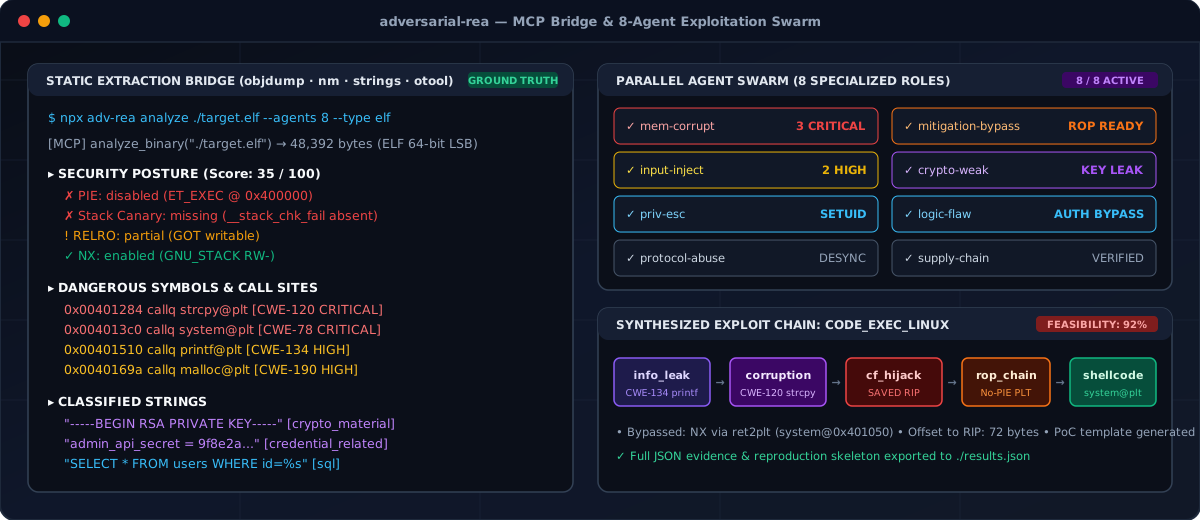
Need to tear apart a native binary, driver, mobile package, or firmware image without source code? Connect your MCP client to Adversarial REA or launch adv-rea straight from your terminal. It inspects the binary on disk, extracts real symbols, sections, classified strings, and exploit mitigations, and deploys an 8-role parallel swarm to hunt vulnerabilities and assemble multi-stage exploit chains.
Adversarial REA bridges deterministic binary inspection (objdump, nm, strings, otool, file) with multi-agent offensive workflows across ELF, Mach-O, PE, Android APK, iOS IPA, Electron ASAR, WebAssembly, and raw firmware targets. Every reported finding includes its CWE classification, trigger conditions, mitigation posture, and exploitation feasibility score.
Quick start
Adversarial REA requires Node.js >= 22.0.0, npm, and standard host binary utilities (objdump, nm, strings, file; plus otool on macOS).
git clone https://github.com/Cultistsid/adversarial-rea.git
cd adversarial-rea
npm install
Set up your MCP client
Add adversarial-rea to your MCP client configuration (mcp.json):
{
  "mcpServers": {
    "adversarial-rea": {
      "command": "node",
      "args": ["/absolute/path/to/adversarial-rea/src/mcp/main.js"],
      "env": {}
    }
  }
}
Restart your MCP client after saving. All 8 binary inspection tools register over stdio JSON-RPC 2.0 and require zero external API keys.
Ask your agent
Run analyze_binary and find_dangerous_patterns on ./target.elf, disassemble any
function that references strcpy or system, and rank the most feasible RCE chain.
Replace ./target.elf with any local ELF, Mach-O, PE, or firmware binary you want to tear down.
Use the terminal
Run the full 3-phase offensive pipeline (Recon → Hunt → Chain) directly from your shell:
# Full analysis pipeline — 8 parallel agents, PE target
npx adv-rea analyze ./target.exe --agents 8 --type pe --output results.json

# Deploy a targeted agent swarm with custom mission and offensive roles
npx adv-rea swarm ./target.elf \
  --mission "Find heap corruption and ASLR leak primitives" \
  --roles mem-corrupt,mitigation-bypass

# Vulnerability hunt — surface critical CWE patterns only
npx adv-rea hunt ./target.apk --critical-only

# Attack surface enumeration only (vectors, trust boundaries, primitives)
npx adv-rea surface ./libtarget.so --type elf-shared
To install the adv-rea command globally for regular terminal use:
npm install --global .
adv-rea --help
How Adversarial REA works
Your MCP client or CLI invocation calls Adversarial REA to extract ground-truth binary structure first, then layers parallel offensive reasoning over those extracted facts. Every claim is anchored to real symbol offsets, section flags, string literals, and mitigation headers.
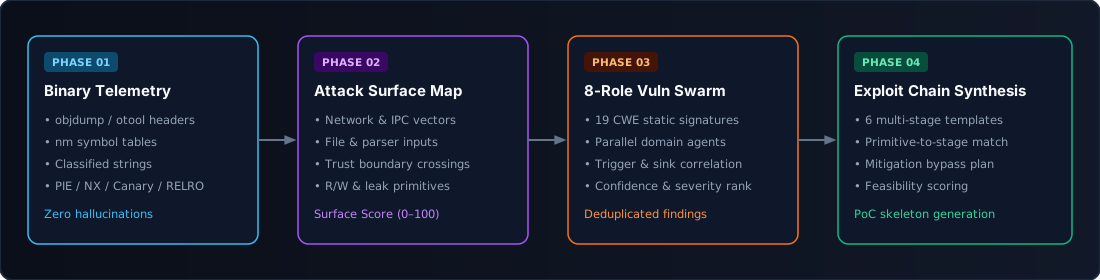
- Deterministic Telemetry (
BinaryAnalyzer) — Executesobjdump,nm,strings,otool, andfileto collect imports, exports, function symbols, section permissions, categorized strings, and platform-normalized mitigation scores. - Attack Surface Enumeration (
AttackSurfaceEnumerator) — Deploys parallel tasks to map entry vectors (network listeners, file parsers, IPC handlers), trust boundaries (user↔kernel,renderer↔broker,pre-auth↔post-auth), and exploitation primitives. - Parallel Swarm Hunting (
AgentSwarm+VulnHunter) — Matches 19 CWE patterns against extracted imports/strings and dispatches up to 8 concurrent specialist roles viap-limit. - Exploit Chain Synthesis (
ExploitChainBuilder) — Matches discovered vulnerabilities against 6 multi-stage exploitation templates, scores stage coverage, and generates PoC skeletons.
What you can analyze
Adversarial REA auto-detects target formats by extension or accepts an explicit --type override:
| Target | What Adversarial REA returns | Underlying primitives & default swarm roles |
|---|---|---|
Linux ELF (.elf, .so) |
Dynamic/static symbols, PLT/GOT imports, GNU_STACK & GNU_RELRO posture, disassembly, RCE chains |
objdump, nm, strings, file · Roles: mem-corrupt, mitigation-bypass, priv-esc, input-inject |
macOS Mach-O (.dylib, .app) |
Mach-O header flags (MH_PIE, stack execution), fortified symbols (_*_chk), section layout, strings |
otool -hv, objdump -h, nm, strings · Normalized 0–100 score (excludes ELF-only RELRO) |
Windows PE (.exe, .dll) |
Import/export tables, dangerous Win32/CRT sinks (ShellExecute, WinExec, HeapAlloc), CFG/DEP chain paths |
objdump, nm, strings · Roles: mem-corrupt, mitigation-bypass, priv-esc, input-inject |
Kernel Drivers (.sys) |
IOCTL dispatch surface, kernel/user trust boundaries, token-stealing & cred-overwrite chains | Roles: mem-corrupt, priv-esc, mitigation-bypass · Templates: PRIV_ESC_WINDOWS / PRIV_ESC_LINUX |
Android Packages (.apk) |
Native JNI library symbols, hardcoded secrets/URLs, intent/IPC injection sinks, supply-chain risks | Roles: logic-flaw, crypto-weak, input-inject, supply-chain |
iOS Packages (.ipa) |
Mach-O binary headers, entitlement/keychain string artifacts, crypto weakness & ASLR bypass analysis | Roles: logic-flaw, crypto-weak, mitigation-bypass |
Electron Archives (.asar) |
Renderer-to-main IPC boundaries, preload bridge sinks, command injection & protocol abuse vectors | Roles: input-inject, logic-flaw, supply-chain, protocol-abuse · Template: SANDBOX_ESCAPE |
WebAssembly (.wasm) |
Linear memory bounds, imported host bindings, integer overflow & logic flaw primitives | Roles: mem-corrupt, logic-flaw, crypto-weak |
Embedded Firmware (.bin, .fw) |
Extracted credentials, PEM/private keys, system/popen command sinks, protocol parser bugs |
Roles: mem-corrupt, crypto-weak, priv-esc, protocol-abuse |
MCP Tool Catalog
Every tool exposed by src/mcp/main.js runs locally with zero network dependencies:
| Tool | What it extracts | Key arguments |
|---|---|---|
analyze_binary |
Full one-shot profile: file metadata, symbol counts, security mitigations, classified strings, and dangerous imports | target_path, strings_min_len (default: 6) |
get_symbols |
Symbol table entries filtered by class (all, imports, exports, functions) and optional regex |
target_path, type, filter |
get_strings |
ASCII strings classified into 9 security categories (credential_related, crypto_material, url, path, sql, etc.) |
target_path, min_length, interesting_only, category |
check_security |
Platform-aware PIE, NX, Stack Canary, RELRO, FORTIFY, and symbol-stripping detection with 0–100 score | target_path |
disassemble |
Full binary or single-function disassembly via objdump -d with line bounding |
target_path, function, limit (default: 200) |
get_sections |
Binary sections with hex/byte sizes, file offsets, and executable vs. data split | target_path |
get_headers |
Architecture, entry point, and format headers (otool -hv / objdump -f) |
target_path |
find_dangerous_patterns |
Exact-matched dangerous imports, hardcoded secret strings, SQL fragments, and missing mitigations tagged by CWE | target_path |
Platform-Normalized Mitigation Scoring
check_security normalizes security scores to 100 per binary format. Because RELRO is an ELF-specific concept, it is excluded from the Mach-O denominator—so a fully hardened macOS binary scores 100/100 rather than being capped at 85.
| Mitigation | Weight | macOS (Mach-O) Detection |
Linux (ELF) Detection |
|---|---|---|---|
| PIE | 20 |
MH_PIE flag via otool -hv |
ET_DYN / DYNAMIC in objdump -f |
| NX | 20 |
Absence of ALLOW_STACK_EXECUTION flag |
GNU_STACK header without E flag |
| Stack Canary | 20 |
__stack_chk_fail / __stack_chk_guard symbol |
__stack_chk_fail symbol |
| RELRO | 15 / 7 |
n/a (excluded from Mach-O max) |
GNU_RELRO + BIND_NOW (full = 15, partial = 7) |
| FORTIFY | 15 |
__memcpy_chk, __sprintf_chk, _*_chk imports |
_*_chk fortified symbol imports |
| Stripped | 10 |
Total symbol count < 10 |
Total symbol count < 10 |
Agent swarm roles
Eight specialist roles execute in parallel during adv-rea analyze and adv-rea swarm:
| Role ID | Specialist Name | Offensive Focus Areas |
|---|---|---|
mem-corrupt |
Memory Corruption Hunter | Stack/heap buffer overflows, use-after-free, double-free, type confusion, integer wraparound |
logic-flaw |
Logic Flaw Analyst | Authentication bypass, race conditions, TOCTOU, state machine abuse |
crypto-weak |
Cryptographic Weakness Finder | Weak ciphers (DES, RC4), hardcoded keys, IV reuse, padding oracles, timing side-channels |
input-inject |
Input Injection Specialist | OS command injection, uncontrolled format strings, SQL injection, unsafe deserialization |
mitigation-bypass |
Mitigation Bypass Expert | ASLR info leaks, DEP/NX bypass via ROP/JOP, CFG/CET evasion, stack canary leaks |
priv-esc |
Privilege Escalation Hunter | Kernel/driver IOCTL flaws, setuid abuse, DLL/dylib hijacking, service misconfigurations |
protocol-abuse |
Protocol Abuse Analyst | Protocol confusion, request smuggling, state desynchronization, parser differentials |
supply-chain |
Supply Chain Analyzer | Vulnerable dependencies, build tampering, signature verification bypass, update hijacking |
Vulnerability Patterns (CWE Coverage)
View all 19 CWE vulnerability signatures (Critical, High, Medium)
| Severity | CWE | Pattern Class | Monitored Sinks & Indicators |
|---|---|---|---|
| Critical | CWE-120 |
Buffer Copy Without Checking Size | strcpy, strcat, gets, sprintf, vsprintf, scanf |
| Critical | CWE-122 |
Heap-Based Buffer Overflow | malloc, calloc, realloc, HeapAlloc size arithmetic |
| Critical | CWE-416 |
Use After Free | Post-free / delete pointer reuse across error paths |
| Critical | CWE-415 |
Double Free | Duplicate deallocation in cleanup handlers |
| Critical | CWE-843 |
Type Confusion | Unsafe casts, union discriminator mismatches, vtable corruption |
| Critical | CWE-78 |
OS Command Injection | system, popen, execve, execl, execvp, ShellExecute, WinExec |
| High | CWE-134 |
Uncontrolled Format String | printf, fprintf, sprintf, snprintf, syslog |
| High | CWE-190 |
Integer Overflow or Wraparound | Unchecked multiplication/addition before buffer allocation |
| High | CWE-287 |
Improper Authentication | authenticate, login, verify_password, check_auth |
| High | CWE-798 |
Hardcoded Credentials | password, passwd, pwd, secret, api_key, apikey, token |
| High | CWE-321 |
Hardcoded Cryptographic Key | Embedded PEM blocks, static AES/HMAC/private key buffers |
| High | CWE-327 |
Broken Crypto Algorithm | DES_, RC4, ECB block cipher usage |
| High | CWE-328 |
Reversible One-Way Hash | MD5_Init, MD5_Update, SHA1_Init, SHA1_Update |
| Medium | CWE-22 |
Path Traversal | fopen, open, stat, access, CreateFile |
| Medium | CWE-89 |
SQL Injection | sqlite3_exec, mysql_query, PQexec, raw SQL query strings |
| Medium | CWE-338 |
Weak PRNG | rand, srand, random in security-sensitive contexts |
| Medium | CWE-732 |
Incorrect Permission Assignment | chmod, fchmod, chown, umask |
| Medium | CWE-770 |
Allocation Without Limits | Unbounded alloca on stack frames |
| Medium | CWE-119 |
Missing Exploit Mitigations | Non-PIE executable or missing stack canary |
Showcases
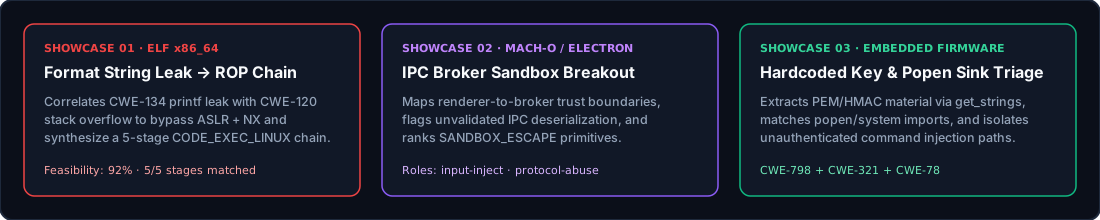
1. Linux ELF: Format string leak to 5-stage ROP chain
Inspect an unstripped ELF service binary with analyze_binary, flag an uncontrolled printf (CWE-134) alongside a stack strcpy (CWE-120), and automatically assemble the CODE_EXEC_LINUX template (info_leak → memory_corruption → control_flow_hijack → rop_chain → shellcode_exec).
2. Desktop / Electron: IPC broker boundary breakout
Enumerate renderer-to-broker trust boundaries with adv-rea surface, deploy the input-inject and protocol-abuse swarm roles to audit message deserialization handlers, and score SANDBOX_ESCAPE chains.
3. Embedded Firmware: Hardcoded crypto & command injection triage
Extract crypto_material and credential_related strings from a raw .bin image via get_strings, cross-reference popen/system symbol imports with get_symbols, and isolate unauthenticated root command execution sinks.
Exploit chain templates
ExploitChainBuilder matches discovered vulnerabilities and primitives against 6 built-in exploitation templates and ranks feasible chains by stage completeness:
| Template | Stage Progression | Target Objective |
|---|---|---|
CODE_EXEC_LINUX |
info_leak → memory_corruption → control_flow_hijack → rop_chain → shellcode_exec |
Arbitrary code execution on Linux (ASLR + NX bypass) |
CODE_EXEC_WINDOWS |
info_leak → memory_corruption → cfg_bypass → control_flow_hijack → rop_chain → shellcode_exec |
Arbitrary code execution on Windows (ASLR + DEP + CFG bypass) |
PRIV_ESC_LINUX |
kernel_info_leak → kernel_vuln_trigger → cred_struct_overwrite → root_shell |
Local privilege escalation to root |
PRIV_ESC_WINDOWS |
kernel_leak → driver_vuln → token_stealing → system_shell |
Local privilege escalation to SYSTEM |
SANDBOX_ESCAPE |
renderer_exploit → ipc_message_forge → broker_vuln_trigger → sandbox_breakout |
Multi-process sandbox escape via IPC broker |
AUTH_BYPASS |
user_enumeration → auth_logic_flaw → session_forgery → privileged_access |
Pre-auth administrative session takeover |
Use the programmatic SDK instead
import { AdversarialREA } from 'adversarial-rea';

const rea = new AdversarialREA({
  maxAgents: 8,
  aggressiveMode: true,
  parallelAnalysis: true,
  timeout: 300000
});

const analysis = await rea.analyzeTarget('./target.elf', {
  type: 'elf',
  buildChains: true
});

console.log('Attack Surface Score:', analysis.attackSurface.score);
console.log('Vulnerabilities:', analysis.vulnerabilities.length);
console.log('Top Exploit Chain:', analysis.exploitChains[0]);
FAQ
Which MCP clients can use Adversarial REA?
Any client or agent runtime that supports local MCP servers over stdio JSON-RPC 2.0. Point the client at node /absolute/path/to/adversarial-rea/src/mcp/main.js in mcp.json.
Does the MCP server require an API key?
No. The MCP server (src/mcp/main.js) executes local binary inspection tools (objdump, nm, strings, otool, file) directly on disk and requires zero API keys or network access. API credentials are only used when running standalone multi-agent LLM swarms via the adv-rea CLI or AdversarialREA SDK class.
Do I need Ghidra, IDA, or Rizin installed?
No. Core binary extraction works out of the box using standard system utilities (objdump, nm, strings, file, and otool on macOS). BinaryAnalyzer automatically detects optional tools (rizin, radare2, ghidra_headless, readelf) when present on your PATH.
Does Adversarial REA upload my binary anywhere?
Never. Binary extraction runs strictly locally via child process execution (objdump, nm, strings, otool). When using the multi-agent swarm CLI, only compact extracted metadata summaries (symbol names, mitigation booleans, and top classified strings) are passed to your configured model endpoint.
How do I run the verification test suite?
Run the unit and live-binary integration suites with:
npm test                   # 61 deterministic unit tests (zero network calls)
npm run test:integration   # Live binary & stdio MCP JSON-RPC integration tests
npm run test:all           # Full 71-test verification suite
Documentation
- MCP Server Usage Guide: registration, tool parameters, example prompts, and extraction-to-findings workflow.
- Agent Skill Specification: offensive methodology, surface scoring formula, and JSON reporting schema.
- MCP Server Manifest: machine-readable capability and tool declarations.