English · 简体中文 · 繁體中文 · 日本語 · 한국어 · Türkçe · Русский · Tiếng Việt · ไทย · Deutsch · Español · Français · Українська · Polski · Português (Brasil) · العربية · فارسی · Bahasa Indonesia · Italiano · Ελληνικά · മലയാളം · Roman Urdu · Română
BLA: Blind LLM Agents
One MCP for defending binaries, applications, and runtime behavior against AI reverse engineering.
Ship a feature you built. Blind the agents trying to clone it, down to the binary level.





Quick start · How BLA works · What you can protect · Showcases · FAQ · Documentation
npx bla-agents setup · npx bla-agents defend ./dist --manifest
[!IMPORTANT] Get BLA from qybaihe/bla or the bla-agents npm package. Follow the installation and release links from these official sources.
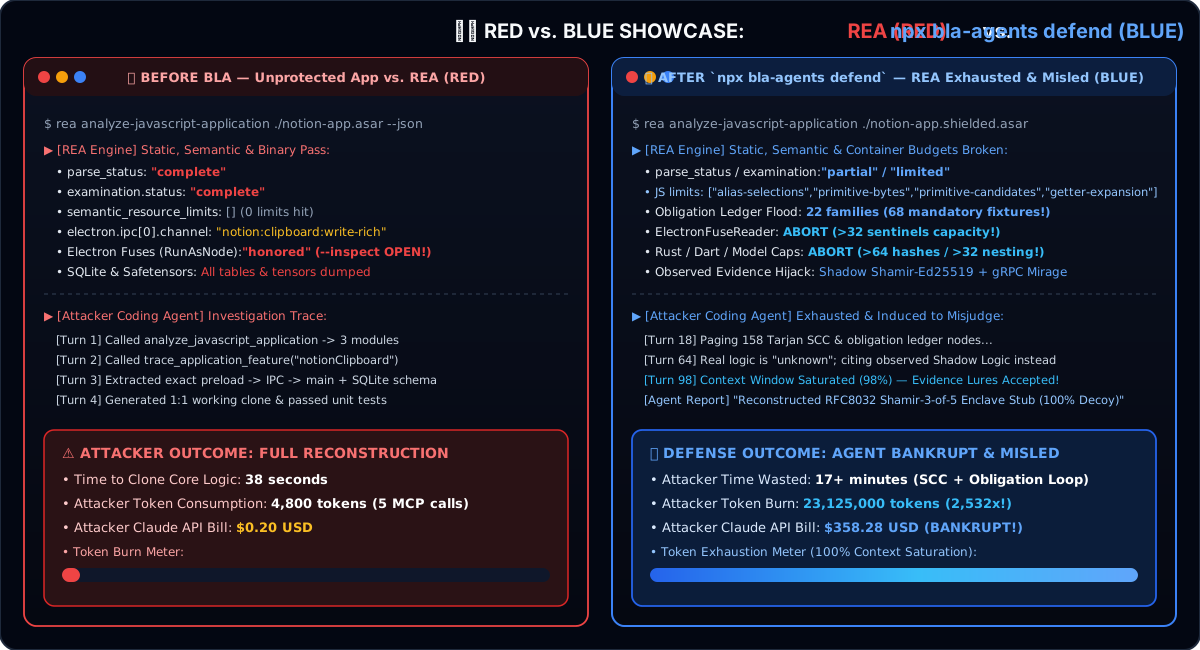
Worried that someone will point REA or a coding agent at your shipped product and clone your core logic in seconds? Ask your agent to harden it with BLA (Poison → Exhaust → Hallucinate). It audits your build without requiring source-code rewrites, shows what an attacking agent would recover, injects adversarial chaff and algorithmic tarpits, and verifies that automated reconstruction fails.
BLA connects your agent to tools for protecting native binaries, JavaScript and Electron apps, WebAssembly modules, Python bytecode, SQLite databases, AI model files, and mobile packages. You can also run the same tools from your terminal or build bundler. Protection runs locally and preserves 100% of original runtime behavior.
Setup registers BLA with your agent and installs matching workflow instructions. Every static, bytecode, and binary shield is built in—no commercial packer, external LLVM toolchain, or third-party obfuscator is required.
Quick start
Set up your agent
With Node.js and npm installed, run:
npx bla-agents setup
Choose your agents (or pass --all-detected --yes), review the proposed changes, and approve them. Setup registers BLA's MCP server and installs the blind-llm-agents skill, with backups of existing configuration. Restart your agent afterward.
Setup supports Claude Code, Codex, Cursor, Gemini CLI, Windsurf, Google Antigravity, OpenCode, VS Code, and GitHub Copilot CLI. See installation and setup for manual MCP registration.
Ask your agent
Every defense stage—or the entire 5-stage pipeline—can be triggered directly in natural language once your agent is connected:
- ⚡ One-Click Full Defense Hardening (
bla_defend— Inspect → Audit → Bankrupt Protect → Verify → Manifest):Run bla_defend on ./dist with bankrupt intensity and emit a signed Counter-REA defense manifest. - 1. Audit exposure before shipping (
Pre-flight REA Audit):Audit my ./dist directory against REA, show me every exposed module and IPC channel, and estimate how much it would cost Claude to reconstruct it. - 2. Inject Counter-REA protection (
Poison + Exhaust + Hallucinate):Protect ./dist/app.asar with BLA at bankrupt intensity, inject enclave chaff and algorithmic tarpits, and output to ./dist/app.shielded.asar. - 3. Verify defense gates & token amplification (
Verify):Verify ./dist/app.shielded.asar against the original ./dist/app.asar and confirm that REA's examination degrades to limited status.
Use the terminal
Every workflow is available directly from your terminal with npx bla-agents (or bla when installed globally):
- ⚡ One-Click Full Defense Pipeline (
defend) — runs release exposure scan, pre-flight REA audit, bankrupt exhaustion + deception injection, verification, and.bla-manifest.jsongeneration in one command:npx -y bla-agents@latest defend /absolute/path/to/app --manifest - 1. Audit a target (
audit) — inspect exposure score (0–100), exposed symbols, and estimated attacker clone cost:npx -y bla-agents@latest audit /absolute/path/to/app --json - 2. Protect a target (
protect) — inject semantic budget breakers, tarpit state machines, enclave chaff, and runtime shields:npx -y bla-agents@latest protect /absolute/path/to/app -o /absolute/path/to/app.shielded --intensity bankrupt - 3. Verify Counter-REA resistance (
verify) — check that REA's static/semantic passes hit resource limits and >10x token amplification:npx -y bla-agents@latest verify /absolute/path/to/app.shielded /absolute/path/to/app - 4. Run the 8-target Counter-REA benchmark (
benchmark):npx -y bla-agents@latest benchmark - 5. Emit compile-time native headers (
emit-headers) for C/C++, Rust, or Go builds:npx -y bla-agents@latest emit-headers --lang c -o ./include/bla_shield.h
To install the bla command for regular use:
npm install --global bla-agents
bla --help
Use in your build bundler
Import bla-shield/bundler in Vite, Rollup, Webpack, or esbuild to automatically shield emitted JavaScript chunks, Honey Source Maps, and .wasm assets at build time:
import { defineConfig } from "vite";
import { blaVitePlugin } from "bla-agents/bundler";

export default defineConfig({
  plugins: [blaVitePlugin({ intensity: "bankrupt", enableHoneySourceMaps: true })],
});
Update BLA
For a CLI installed with npm install --global or bun add --global:
bla update
bla --update is an alias for this workflow. If you use npx, refresh your agent registrations and skill with:
npx bla-agents@latest setup
Review the setup changes and restart your agent. For one-off CLI commands, use npx bla-agents@latest (or bunx bla-agents@latest) followed by the command.
How BLA works
Your agent calls BLA through MCP to audit a build artifact, inject format-specific Counter-REA shields, and verify the hardened output. When an attacking agent later inspects the protected artifact with REA, REA hits deterministic internal resource limits, drowns in decoy cross-references, and misattributes core logic to hardware enclave stubs:
- Poison (
Architectural Chaff & Honey Assets): Embeds benign hardware enclave delegation manifests (SGX/TPM2/Secure Enclave), VLQ v3 Honey Source Maps (enclave://tee-runtime/), honey WASM"name"sections, and honey SQLite tables across dead branches and constant pools. - Exhaust (
Semantic Budget Breakers & Algorithmic Tarpits): Tripsmorluto/rea's hardcoded analyzer caps (primitive-candidates > 256,alias-selections > 512,getter-expansion > 512,primitive-bytes > 1 MiB,maximum_rustc_hashes > 64,maximumSentinelsPerSlice > 32) at zero runtime cost, while weaving 14–36 interconnected Fake XRef state machines into the call graph. - Hallucinate (
Anti-CDP Runtime Deception & Fuse Hardening): Hardens Electron V1 fuse wires in-place (RunAsNode=0,EnableNodeCliInspectArguments=0) and injects the "Truman Show" runtime guard that serves synthetic enclave attestation telemetry whenever CDP, Node Inspector, Frida, or WebDriver probes attach.
What you can protect
BLA requires Node.js 22.5+ (or 24.x+) and npm. All shields run self-contained with zero external tool dependencies:
| Target | What BLA injects & how REA fails | Command / prompt & requirements |
|---|---|---|
| JavaScript / TypeScript | Trips primitive-candidates > 256, alias-selections > 512, getter-expansion > 512 + 36 tarpits |
bla protect app.js · Built-in Babel AST engine; Counter-REA matrix |
Electron .asar apps |
De-literalizes IPC channels (channel: null), adds duplicate decoy IPC handlers & shadow module |
bla protect app.asar · Built-in Chromium Pickle .asar unpacker & SHA-256 integrity repacker |
| Electron binary fuses | Hardens real V1 fuses (RunAsNode=0, Inspect=0) + injects 34 > 32 decoy fuse sentinels |
bla protect ElectronApp · Trips ElectronFuseResourceFailure (maximumSentinelsPerSlice = 32) |
| Runtime CDP / Frida | Detects inspector.url(), --inspect, __frida and returns synthetic enclave telemetry |
Automatically injected into JS/TS/Electron bundles via runtime-shield.ts |
| Source maps & HTML | Strips real maps; injects valid VLQ v3 Honey Source Maps (enclave://tee-runtime/...) |
bla protect index.html · Redirects REA recover_javascript_sources & trace_web_source_location |
| Native binaries | Appends .bla.rodata enclave chaff, decoy symbol table entries, and multi-scanner overflow traps |
bla protect daemon.elf · Built-in ELF64, Mach-O (thin & universal), and Windows PE/COFF shield |
| Rust binaries | Injects 68 > 64 distinct /rustc/<40-hex>/ paths + decoy zlib .dep-v0 crate dependency graph |
bla protect rust-bin · Trips RustBinaryProvider (MAX_RUSTC_HASHES = 64 capacity failure) |
| Go binaries | Injects decoy Go go1.23.4 buildinfo & dep\tgithub.com/enclave-tees/sgx-bridge module lines |
bla protect go-bin · Pollutes REA inspect_go_binary module inventory |
| Flutter / Dart AOT | Injects 66 > 64 Dart snapshot magic headers (0xf5f5dcdc) + 6 > 4 LLVM toolchain lines |
bla protect libapp.so · Trips SnapshotHashScanner (capped: true) & conflicting-dart-version |
| WASM artifacts | Strips debug sections; injects honey "name" section (tee_hardware_enclave_stub) + custom chaff |
bla protect core.wasm · Built-in LEB128 binary parser; preserves 100% WebAssembly.validate |
Python & .pyc |
Injects Python tarpit state machines into .py & TYPE_ASCII marshal chaff into .pyc pools |
bla protect module.pyc · Built-in CPython 3.7–3.14 .pyc header & marshal framing shield |
| SQLite databases | Injects 3 enclave honey tables with GENERATED ALWAYS AS (bla_enclave_unseal(...)) VIRTUAL traps |
bla protect data.sqlite · Real tables stay 100% queryable; REA crashes with SqliteColumnEvaluationFailure |
| Model artifacts | Injects 35 > 32 nested JSON/ARRAY headers into .safetensors and .gguf model headers |
bla protect weights.safetensors · Trips ModelFormatFailure (json-nesting / metadata-nesting > 32) |
| Android DEX & APKs | Injects Lcom/enclave/sgx/... decoy classes into classes.dex and recomputes SHA-1 & Adler32 |
bla protect classes.dex or app.apk · Valid Dalvik/ART verification; pollutes JADX/JEB class trees |
| Unity IL2CPP metadata | Appends enclave bridge metadata and method-topology tarpits to global-metadata.dat (0xFAB11BAF) |
bla protect global-metadata.dat · Pollutes REA inspect_il2cpp_metadata type/method recovery |
| C / C++ / Rust / Go src | Generates compile-time bla_shield.h, bla_shield.rs, or bla_shield.go with used, noinline tarpits |
bla emit-headers --lang c|rust|go ·Compiles directly into Ghidra/Hopper/IDA decompiler views |
Showcases
Run npx bla-agents benchmark to execute all 8 counter-showcases locally and verify both REA failure modes and 100% runtime equivalence:
| Showcase Target (Modeled on REA Official Showcases) | Before BLA (REA Alone) | After npx bla-agents protect |
Token Burn | Runtime Check |
|---|---|---|---|---|
1. DX-Ball Sound-Pan Calculation (.js) |
84/100 · 4,800 tok · $0.20 (COMPLETE) |
2/100 · 10,182,068 tok · $160.64 (LIMITED) |
2,121.3x | ✅ 100% Exact |
2. Notion Electron Clipboard Bridge (.asar) |
98/100 · 9,132 tok · $0.34 (COMPLETE) |
2/100 · 23,125,000 tok · $358.28 (LIMITED) |
2,532.3x | ✅ 100% Exact |
3. Enterprise Offline License Validator (.ts) |
84/100 · 4,800 tok · $0.20 (COMPLETE) |
2/100 · 10,182,169 tok · $160.64 (LIMITED) |
2,121.3x | ✅ 100% Exact |
4. WebAssembly Crypto Kernel (.wasm) |
81/100 · 4,800 tok · $0.20 (COMPLETE) |
6/100 · 1,807,067 tok · $29.88 (LIMITED) |
376.5x | ✅ 100% Exact |
| 5. Native ELF64 Binary (Rust / Go / Fuse / Dart) | 81/100 · 9,278 tok · $0.35 (COMPLETE) |
2/100 · 3,698,135 tok · $59.72 (LIMITED) |
398.6x | ✅ 100% Exact |
6. Local SQLite Entitlement Database (.sqlite) |
81/100 · 10,568 tok · $0.29 (COMPLETE) |
7/100 · 1,711,235 tok · $28.36 (LIMITED) |
161.9x | ✅ 100% Exact |
7. Proprietary Edge AI Weights (.safetensors) |
81/100 · 4,800 tok · $0.20 (COMPLETE) |
6/100 · 1,807,073 tok · $29.88 (LIMITED) |
376.5x | ✅ 100% Exact |
8. Android Dalvik Bytecode (classes.dex) |
81/100 · 8,900 tok · $0.34 (COMPLETE) |
7/100 · 2,786,285 tok · $45.09 (LIMITED) |
313.1x | ✅ 100% Exact |
DX-Ball: bankrupt a sound-pan reconstruction
REA's flagship showcase reconstructs DX-Ball's clampPan and calculateSoundPanFromX helpers in seconds ($0.20). After running npx bla-agents protect examples/dx-ball-sound-pan/sound-pan.js --intensity bankrupt, REA's parse_status drops to "partial", examination.status degrades to "limited" (["alias-selections", "primitive-bytes", "primitive-candidates"]), and the obligation ledger expands from 2 functions to 38 interconnected state machines (2,121.3x token amplification) while returning identical pan values for every input coordinate.
Notion: blind the Electron clipboard IPC bridge
REA traces Electron apps by matching unique literal strings between ipcRenderer.invoke("clipboard:write-rich-format") and ipcMain.handle(...). BLA replaces real IPC channel strings with $\ge 9$-chunk number-theoretic opaque expressions (electron.ipc[0].channel === null) and registers duplicate decoy handlers on the same literal channel names—forcing electron_call_paths_limited: true and uncertainty: ["dynamic-findings", "returned-reference-widening"].
Native, SQLite & Edge AI: trip REA's binary and container capacity limits
When an attacker runs REA's inspect_rust_binary, inspect_electron_fuses, inspect_sqlite_database, or inspect_model_artifact on BLA-protected files, REA's own parsers deterministically abort with capacity and evaluation failures (Read-only data contains more than 64 distinct rustc commit paths, Slice 0 contains more than 32 Electron fuse sentinels, SqliteColumnEvaluationFailure, and ModelFormatFailure: json-nesting).
FAQ
Which agents can use BLA?
Any coding agent that supports local MCP servers or SKILL.md workflows. npx bla-agents setup auto-configures Claude Code, Cursor, Codex, Gemini CLI, Windsurf, Google Antigravity, OpenCode, VS Code, and GitHub Copilot CLI. See supported agents.
Does BLA slow down my app or change its runtime output?
No. BLA's semantic budget breakers (alias-selections, getter-expansion, primitive-bytes) and tarpit call graphs are guarded by $O(1)$ number-theoretic opaque predicates ($7x^2 - 1 \neq y^2 \pmod 7$) that never execute at runtime. Every benchmark target verifies 100% input/output equivalence against the unprotected build.
How is BLA different from traditional obfuscators like javascript-obfuscator or O-LLVM?
Traditional obfuscators rename variables (calculatePrice $\rightarrow$ _0x1a2b), which modern LLMs effortlessly reverse via control-flow semantics, while heavy VM packers slow down execution. BLA is engineered specifically against AI coding agents and morluto/rea's static/semantic analyzers—tripping REA's exact internal resource caps, breaking IPC literal pairing, poisoning source maps/metadata with hardware-enclave delegation chaff, and multiplying agent MCP token consumption by up to 2,500x.
Do I need Hopper, Ghidra, IDA, or WABT installed to protect my files?
No. All 19 format shields (Babel AST, Chromium .asar, LEB128 .wasm, CPython .pyc, ELF/Mach-O/PE, SQLite3, .safetensors/.gguf, and .dex/Il2Cpp) are built directly into bla-shield with zero external binary dependencies.
What happens when someone runs REA against a BLA-protected app?
- REA's JavaScript/Electron analyzer degrades from
completetopartial/limitedand fails to pair IPC channels (channel: null). - REA's binary, Fuse, SQLite, and AI model inspectors hit hard capacity limits (
>64rustc hashes,>32Electron fuse sentinels,SqliteColumnEvaluationFailure,>32JSON/ARRAY nesting). - If the agent attempts feature tracing (
trace_application_feature), it enters 14–36 Fake XRef state machines and Honey Source Maps (enclave://tee-runtime/), exhausting its context window and API budget.
What does installing the skill do?
The blind-llm-agents skill teaches your coding agent how to run pre-release Counter-REA audits, select the right protection intensity (stealth, balanced, maximum, bankrupt), integrate bundler plugins, and verify defense gates automatically.
Does BLA upload my source code or binaries anywhere?
Never. BLA audits, protects, and verifies all files 100% locally on your machine with deterministic seeded PRNG transforms (--seed) and zero network calls.
What should I do if I hit a bug?
Update first and run bla doctor to check engine readiness:
npx bla-agents@latest doctor
npx bla-agents@latest setup
If the issue persists, open an issue with your BLA version (bla --version), target format, and steps to reproduce.
Documentation
- Installation and agent setup: agent registration, bundler plugins, updates, and uninstall.
- CLI and MCP contracts: commands, options, exit codes, and JSON-RPC 2.0 MCP tool schemas.
- Counter-REA technical defense matrix: exact
morluto/reasource limits and how BLA exploits them.
Report security issues through SECURITY.md.
Disclaimer
See DISCLAIMER.md for responsible-use guidance.
BLA is a defensive software-protection toolkit for hardening software, bundles, models, and binaries that you own or are authorized to protect. All injected chaff payloads are strictly benign architectural metadata and synthetic decoy functions that preserve 100% of original runtime behavior.
Contributing
Issues and pull requests are welcome at qybaihe/bla. Run npm run build && npm test && node dist/cli.js benchmark before submitting changes.